

Salvation Is Our Song
I’m a firm believer in the power of song. Somehow, when we sing, our spirits are lifted and we are encouraged. When we sing truth, we are set free.
People believe you have to be happy to sing. In truth, singing brings happiness. It leads to joy. We don’t always sing because we are happy; we sing our way out of trouble, as Martin Smith profoundly puts it in his song, ‘Trouble.’ We sing praise to God because He is always worthy of our praise, no matter how we feel. He is always worth it!

Eugene Peterson reminds us that the scriptural command to lift up your hands to the Lord is a simple motor action that has nothing to do with feelings and everything to do with will, with choice. So it is with singing. Some people only sing, only lift their hands, when they are in a crowd or when they ‘feel like it.’ Martin Smith’s song reminds us if we sing, we will eventually find freedom: ‘I‘m gonna sing till I am free.’ We don’t just sing when we see God work. We sing in faith that He will work: ‘Our God will find us here in the rubble/ O Rock of ages, You will save us once again.’
Last night in our prayer meeting, we were reminded of the song ‘The hills are alive with the sound of music’ (from the musical ‘Sound of Music‘). It is our prayer that the Dearne Valley will resound with songs of praise to God. We have a glorious heritage of choirs locally: Thurnscoe Harmonic Male Voice Choir and now the exciting work of Barnsley Youth Choir, including BYC East Children’s Choir which meets weekly in Goldthorpe, training our 7-12 year olds to sing. But more than these wonderful choirs, our prayer is for God’s people to sing their way out of trouble because ‘salvation is our song.‘ How can we keep from singing when our God is so good?

An Angel Scarecrow


The Beloved’s Search
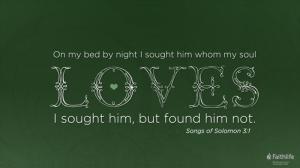
Like the book of Esther, Song of Songs does not mention God directly and its sensual nature puts many off reading it. But all Scripture is God-breathed and useful to us (2 Tim 3:16) and Dave spoke tonight from Song of Songs 3:1-4 about the need for God’s people to seek Him.
The book is an allegory and parable, showing on one level the love relationshp between a man and a woman (‘Lover’ and ‘Beloved’) and the struggles which they must overcome to enjoy true love. The allegorical nature of the book points to the church as the Beloved of God, the Bride of Christ. Jesus died for us so that we could be reconciled to God; the joy set before Him was that of presenting a spotless bride one day (see Heb 12:2). We may be like the woman in the story, doubting whether the Lover will return as he promised. In chapter 3, we see how she misses meeting her lover and longs to find him, even roaming the streets at night in her search for him. We too can sometimes feel that we have lost the intimate presence of Jesus and need to search for Him, for He is our passion and our delight.
When we cannot feel God’s presence with us, we must search the Scriptures, continue in prayer and stay in fellowship, for nothing is more important than our personal relationship with the Lord. We have to do hold on to Him when we do find Him, by faith, trusting in Him and resting in Him. We have to pursue God with all our hearts, for we love because He first loved us. Nothing is more important than seeking the Lord, and those who seek Him will be found by Him.
Seeking God and His Kingdom
Mark Burgin spoke this morning from Matt 6:25-34, focussing on our need to seek God and His kingdom above all. When playing ‘Hide & Seek’ with grandchildren, it gets harder to find them as they get older and become more adept at hiding; sometimes we really have to seek hard! In the same way, seeking God has to be our first priority in life.
Living life God’s way has to be our number one priority. 2 Chron 7:14 reminds us that this involves humbling ourselves, repenting, seeking God and praying continually. We must be sure to be seeking God’s face, reclaiming our first loe. Moses met with God face-to-face; Ps 63:1 talks of earnestly seeking God’s face. Do we long and thirst for God, seeking Him early in the morning? Do we continue to seek Him throughout our busy days and last thing at night? God is looking for people who will seek Him whole-heartedly, avoiding distractions. It’s true, though, that God is also seeking us (see John 4:23-24). He is looking for people who will worship Him in spirit and truth. When His searching meets our seeking, then there is an explosion of divine grace and we are changed by our life in God.

Visions and Numbers
Numbers in the book of Revelation have been debated for years. Whether they are meant literally or metaphorically can be discussed endlessly, with few incontrovertible conclusions reached. In Revelation 4:1-11, we see twenty-four thrones and twenty-four elders as well as God’s throne; we also see four living creatures covered with eyes alongside seven lamps blazing who are identified with the seven spirits of God. What are we to make of all these numbers?
It’s impossible to be dogmatic about these things. Seven is usually understood as the number signifying completeness or perfection, and the ‘seven spirits of God’ may refer back to Isaiah 11, indicating different aspects of God’s Spirit. The four living creatures have been identified with different aspects of the four gospels, but given their similarity to the visions of Isaiah and Ezekiel (Isaiah 6, Ezekiel 1) may well refer to angelic beings who worship God for His holiness and majesty. The twenty-four thrones and twenty-four elders refer to angels according to some commentators, but their white robes, gold crowns and prostrate worship may also represent the whole of God’s people, with the twelve tribes of Israel and the twelve apostles of the New Testament acting as a representative body of all those who have been saved by God.
What is clear, however, is that these creatures are not the focus of the vision. The focus of the vision is God’s throne; these creatures worship God ceaselessly. Worship, to paraphrase C. S. Lewis, is the serious business of heaven. Worship of God relates to who He is (‘holy, holy, holy is the Lord God Almighty, who was, and is, and is to come’ Rev 4:8) and to what He has done (‘for you created all things, and by your will they were created and have their being’ Rev 4:11). We can start our worship now by declaring these truths aloud in the presence of God.

The Bread Of Life


