

The Lost Sheep
Tonight’s evening service looked back on the Team Building Day, with the children giving us their decorated hearts as a symbol of the love we are all called to have for each other.

Then Jeanette sent us on a hunt for lost sheep, which the children were very good at finding!


In the Parable of the Lost Sheep (Luke 15:1-7), Jesus told a story about a shepherd who went looking for one lost sheep, even though, out of a flock of 100, this might not seem to have made much sense. Surely he could stand the loss of one sheep? But the shepherd cared enough to go and find the lost sheep.

Having found the sheep, the shepherd returned to great celebrations – so we got instruments out to celebrate with music!

God’s love for each one of us is so great that He goes looking for every person who does not know Him and there is great rejoicing in heaven when one person returns to Him. That’s a massive party! – and a massive incentive to us all to demonstrate the caring, searching heart of the shepherd to those around us who do not yet know the good Shepherd.
Learning Styles
All of us have different styles of learning. In general, the seven most popular learning styles are:
-
Visual (spatial): You prefer using pictures, images, and spatial understanding.
-
Aural (auditory-musical): You prefer using sound and music.
-
Verbal (linguistic): You prefer using words, both in speech and writing.
-
Physical (kinesthetic): You prefer using your body, hands and sense of touch.
-
Logical (mathematical): You prefer using logic, reasoning and systems.
-
Social (interpersonal): You prefer to learn in groups or with other people.
-
Solitary (intrapersonal): You prefer to work alone and use self-study.
Preaching is usually done verbally through one person speaking to a group of people. This suits some people, but others respond better to visual stimuli (which is why we may use PowerPoints to illustrate sermon points, to help those who learn that way) and others respond better to physical means (moving around and doing things like crafts and puzzles to reinforce truth.) We need to pay careful attention to what we have heard and been taught (see Heb 2:1), because if we do not, it’s all too easy to let God’s word slip through our fingers without retaining it.
John urges us to see that what we have heard from the beginning remains in us. (1 John 2:24) We have to make a conscious effort to remember what we have received and heard and hold it fast. (Rev 3:3) As Casting Crowns sing, it’s so easy to lose our ‘follow through’ between the altar and the door (‘The Altar & The Door’, Casting Crowns): we may be moved intensely during a church service, but how much do these truths affect us once we leave the building? God’s word has the power to shape us and mould us, but only as we respond in faith and obedience to what God says to us through His word.

Listening and Retaining
In the 18th and 19th centuries there was an explosion in the field of engineering: names like James Watt, Robert Stephenson and Isambard Kingdom Brunel became famous for their work on bridges and locomotives. It was at this period that understanding of metals became more refined, with people understanding more about the strength of metals both in tensile and compressive loads and predicting how much material was needed to do a job without it failing and without using too much material. Eventually, engineers came to understand that unexpected failures occurred due to metal fatigue, when small cracks led to more catastrophic failures as metals were bent and stressed.
Knowledge is a vitally important part of our lives, but knowledge is not the be-all and end-all of a life of faith. In Hos 4:1-6, we read how God’s people were destroyed from lack of knowledge, how they rejected knowledge. Nonetheless, we can be always learning and never able to come to a knowledge of the truth (see 2 Tim 3:6-7). For most of us, knowing about the Industrial Revolution and thisknowledge about metal fatigue doesn’t have much impact on our daily lives. What we need is life-changing knowledge, and a knowledge of the truth has the potential to do this.
The aim of preaching is to educate, illuminate, remind and to give understanding and instruction (see Neh 8:9); God’s word is preached ultimately so that our lives are changed. We need to understand that listening is not a spectator sport. We need to take what is preached and check it out against God’s word (see Acts 17:11-12); we need to learn to differentiate between fact and opinion. Ultimately, Heb 4:2 reminds us that the message the Israelites heard was of no value to them because they did not mix what they heard with faith. Just as cement is no use to the builder unless it’s mixed with water, so our listening to God’s word doesn’t do us any good unless we mix it with faith and obedience (James 1:22). It’s not enough to let the word go in one ear and straight out of the other! We need instead to act on what we hear; we need to put into practice what we have learned. (Phil 4:9)
 How do we retain God’s word? This might mean taking notes from a sermon or reading the church blog afterwards or listening again to the sermon via the church website. It might mean learning God’s word off by heart so that we can hide His word in our hearts. Paul told Timothy to keep what he had heard as the pattern of sound teaching and guard this (2 Tim 1:13-14). ‘To keep’ in this context means to hold in the sense of wearing. It’s no good holding a life jacket; if it’s going to do any good, we have to wear it! In the same way, we need to ‘wear’ God’s truth, knowing that the Holy Spirit helps us to guard truth.
We have a great responsibility when we listen to God’s word. God doesn’t waste words and we need to examine, retain and believe what we hear from Him, because as we hold it, it will hold us.
Hearing
The Bible has much to say about hearing. A repeated phrase in Revelation is ‘whoever has ears, let them hear what the Spirit says to the churches.’ (Rev 2:7, 11, 17, 29; Rev 3:6, 13,22). That may seem an odd phrase to us, for there are very few people without ears. What it’s really talking about is not the physical anatomy of ears, but if we are actually listening and hearing what God is saying. The Message version talks about our ears being awake.
At the moment, Garry is having trouble hearing in his left ear because of a build-up of wax. He’s deaf in that ear. This morning, I was downstairs when his alarm clock went off and instead of him turning it off, the noise of the alarm continued, getting louder and louder and more insistent. I had to go upstairs to wake him, astonished that he wasn’t disturbed by the noise. He was lying next to it, oblivious, while I was disturbed by it a relatively long way away! He couldn’t hear it because of the wax blockage in his ear.

We can be like that when God speaks to us. We simply don’t hear Him. Our ears are clogged up with the noise from the world, deafened by our own sin and by the culture all around us.
We need God to open our ears so we can listen. (Ps 40:6) The Hebrew word here is ‘dug out’. We need God to unclog our ears, to dig out the wax, to open the channels again so we can hear Him speak.
How does this happen? The chief way, it seems to me, is actually stopping to listen. We are adept at multi-tasking, but this creates half-hearted listening. To truly listen to God, we have to slow down and give Him our undivided attention. Jeremy Camp sings, ‘I need to stop so I can hear You speak’ (‘Slow Down Time’, Jeremy Camp) and this seems to me to be the first step. Instead of being proud of our ability to multi-task, we need to understand that we need to stop and spend time with God, with no other item on our agenda, that we need to listen in this time and not just talk.
Secondly, for us to hear God, we have to soften our hearts. Just as Garry needs ear drops to soften the wax which is the blockage preventing his hearing, hard hearts don’t hear God well. We have to allow God in if we’re going to hear Him. Every time we hear His voice and ignore Him (‘it wasn’t really God; it’s not convenient to do that; I don’t want to forgive X or give to Y’), we are actually making it harder to hear Him again.
Thirdly, hearing (listening) is allied to doing. (James 1:22-23) If we hear God and don’t do what He says, we’ll find it harder to hear Him next time. When God speaks, it’s not usually “information only.” He speaks to us to shape us, mould us and transform us. He speaks to us so we can be involved in His transformation of society. We need to get used to hearing and obeying.
Coming soon in May…
It’s hard to believe May is already here! This year seems to be flying by… Here are a few things that are happening locally this month for your diaries.
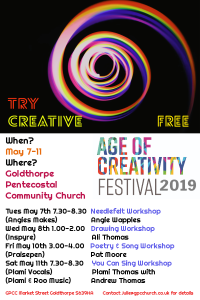
The Age of Creativity Festival is a national festival celebrating creativity. We are hosting 4 workshops at Goldthorpe Pentecostal Community Church, encouraging people to have a go at something creative they may not have tried before. All sessions are free and there’s no need to book – just turn up! All sessions are run by Christians from local churches who are very talented in these area.
- Tuesday 7th May, 7.30-8.30 p.m. Needlefelting with Angie Wapples
- Wednesday 8th May 1.00-2.00 p.m. Learn to draw with Ali Thomas
- Friday 10th May 3.00 -4.00 p.m. Poetry & Singing workshop with Pat Moore
- Saturday 11th May 7.30-8.30 p.m. You Can Sing! workshop with Plami & Andrew Thomas
On Wednesday 22nd May we have our monthly ‘Churches Together’ prayer meeting, which this month will be at St Helen’s Church Hall (High Street) in Thurnscoe at 10.30 a.m. Join us to pray for our churches and communities as we prepare for the Family Fun Day celebrating Pentecost on Wednesday 29th May (at Houghton Road Centre in Thurnscoe. 10 a.m. – 1 p.m.) and the 4FrontTheatre production of Fisherman’s Tail at St Helen’s Church Hall on Tuesday 25th June at 6.30 p.m. Both of these events are great outreaches so please do invite your friends, neighbours and family to come along!

Please pray also for the 4 schools we will be visiting with Fisherman’s Tail in June (The Hill & Gooseacre Primary in Thurnscoe and Lacewood and Carrfield schools in Bolton-on-Dearne).
How Do We Measure Up?
The early church as described in Acts 2:42-47 was a learning, loving, caring, sharing, worshipping, witnessing church. We may feel we don’t measure up very well and it’s always good to ponder carefully our shortcomings and look at how we can change and improve (the purpose of our ‘Building Blocks’ meetings and team building days.) All such things have to be done in an attitude of expectation and humility: expectation that God hears and answers prayer and an awareness that He is the one that adds to the church those who are being saved, not us. Salvation is His work and He is the head of the church. Nonetheless, it’s good to ask ourselves hard questions about the state of the church as we meditate on these verses in Acts, for these adjectives are useful in considering our church life and our commitment (‘devotion’) to that life.
A learning church
Are we keen to learn? Do we devote ourselves to studying God’s word, both privately and in our corporate gatherings? We live in a society where concentration spans are being eroded; I’ve heard numerous people tell me sermons above ten minutes are ‘too much’ for people to bear. In India, people gather for hours to listen to God’s word because of the value they place on this. We need to be people who are hungry to learn. As Heb 5:11-14 reminds us, we need to grow in our faith, moving from the milk of the word to solid food! How can we demonstrate devotion to the apostles’ teaching and grow through our delight in God’s word?

A loving, caring, sharing church
Jesus firmly placed the emphasis on loving God and loving each other and told us this is a valuable witness to a world desperate for love. ‘As I have loved you, so you must love one another. By this everyone will know that you are my disciples, if you love one another.’ (John 13:34-35) These verses in Acts 2:42-47 challenge us to move beyond being ‘churchgoers who pass each other by on a Sunday’ to believers who share everything together. Community living is messy, heart-breaking, discouraging and frustrating… but it’s also invigorating, reassuring, exuberant and worth it! We need to learn to care for each other the way those early disciples did. Perhaps that starts with a phone call or visit to someone this week, just reminding them that they are loved and appreciated? At our recent Team Building day we discussed the different ‘love languages’ needed for different personalities. Perhaps someone needs to hear that they are appreciated and valued. Another person may need you to spend time with them to signify they’re important. Someone else may need a hug, that physical touch that connects them to another person or perhaps a bunch of flowers or small gift may be the way to their heart. Someone else may need to see love in action – mowing a lawn or making a drink, perhaps. Whatever the means, as we focus on the needs of others, we can serve Jesus and show His love to others.

A worshipping church
When we worship, we take our eyes off ourselves and fix them on God. When we join together in prayer, singing, reading the Word and sharing Holy Communion, we acknowledge the centrality of God to our lives and we acknowledge that we are not in the driving seat. Only as our eyes are firmly fixed on Jesus can we hope to see the signs and wonders that the early church experienced. (Col 3:1-3) As a church, we need to be firmly rooted and established in God: ‘So then, just as you received Christ Jesus as Lord, continue to live your lives in him, 7 rooted and built up in him, strengthened in the faith as you were taught, and overflowing with thankfulness.’ (Col 2:6-7)

A witnessing church
We need to be committed to witnessing, to outreach, to telling others the good news of Jesus Christ. God is the only one who can save people and add them to the church (Acts 2:47), but we have to be willing to be His witnesses (Ps 107:2, Acts 1:8). Corporate outreach is crucial (helping at the youth club, the Parent & Toddler group, teaching children on Sundays, serving at the coffee morning, talking to the folk at Cherry Tree Court), but there is always more we can be doing. Let’s ask God to show us how we can best fulfil the ‘Great Commission’, as individuals and as a church, and let’s be praying for opportunities to speak to those around us – neighbours, acquaintances, colleagues, friends and family – about the wonderful works of God.
