

Opportunities & Opposition
In our Sunday morning series, ‘Battles and Blessings’, we are looking at the fact that battles and blessings often seem to be like the parallel tracks on a railway line: we experience both simultaneously in our lives. This certainly seems to have been the case in the early church, when opportunities and opposition went hand in hand.


In Acts 3:1-10, we read of an amazing, astonishing miracle: the healing of a man lame from birth. Then Peter gives a sermon explaining what has happened and further testifying to Jesus being the Messiah, disowned and killed by the crowd and the authorities (Acts 3:14-15) but raised to life by God and therefore capable of healing, forgiving and restoring not just one man, but the whole earth. (Acts 3:15-26) This was clearly a great opportunity for witness, which Peter seized with gladness and boldness, but the result was not unmitigated blessing. Instead, Peter and John were arrested while speaking and were jailed. (Acts 4:1-3) As John Stott puts it, “This comprehensive testimony to Jesus as rejected by men but vindicated by God, as the fulfilment of all Old Testament prophecy, as demanding repentance and promising blessing, and as the author and giver of life, physically to the healed cripple and spiritually to those who believed, aroused the indignation and antagonism of the authorities. The devil cannot endure the exaltation of Jesus Christ. So he stirred up the Sanhedrin to persecute the apostles.” (‘The Message of Acts’, John Stott, P 95)
Paul reminds us that we are engaged in a spiritual battle, not one against flesh and blood (Eph 6:10-18). Life will not always be easy, and there will at times be opposition, even from those we counted as friends (Jesus was betrayed by a disciple, not an outsider, and many of the Psalms recount the pain of betrayal and hurt at the hands of a friend.) Our response when opposition comes can vary. More often than not, opposition shakes our faith, causing us to question God. We feel forsaken and wonder why a loving God can ask us to endure such things. But the response of the apostles was very different. Ultimately, they rejoiced ‘because they had been counted worthy of suffering disgrace for the Name.’ (Acts 5:41) If we can learn to do the same, we will seize the opportunities God gives us as Peter did and endure the opposition we face with confidence and unswerving devotion to God.
Repentance & Rest
In Peter’s sermon following the healing of the crippled man, he tells the crowd, ‘Repent, then, and turn to God, so that your sins may be wiped out, that times of refreshing may come from the Lord.’ (Acts 3:19) This gives us a clue as to how we may move from judgment to blessing.
Repentance is the first step, but repentance itself has several steps. To repent means:
-
We see our sin as sin, not just as a ‘mistake’ or a ‘problem’. Rom 3:10 tells us firmly that no one is righteous; Paul goes on to remind us that all have sinned and fall short of the glory of God (Rom 3:23). It’s one thing to accept this in a general sense, but to repent means we have to see our sin, not someone else’s (see Matt 7:3-5). We have to be able to ask, ‘What have I done?’ and accept the answer, even when it is devastating.
-
This correct view of sin leads us to sorrow over our sin. We don’t treat it lightly, but are broken and ashamed of it (see Ps 51:17, Jer 31:19). There is a difference between godly sorrow and worldly sorrow, between remorse and repentance (see 2 Cor 7:10).
-
We are frequently urged to confess our sins. Our Protestant heritage tends to shy away from confession to people, but James 5:16 reminds us to do this. Confession to God is essential (1 John 1:9), but all too often, we shy away from letting others see our sins, which can simply be another way of hiding our sins or allowing pride to have the last word. Confession is not only personal, but we need to learn to identify with and confess the sins of our nation (see Dan 9:4-8, Ezra 9:1-6; Neh 1:6-7)
-
We learn to hate sin as God hates it. Jesus frequently spoke of loving God more than anything else (see Luke 14:26) and we cannot love God fully while we tolerate and condone sin. This does not mean hating people, but we must learn to hate what is evil and cling to what is good. (Rom 12:9)
-
We turn away from our sin. John Piper says, ‘Repentance means little if it does not result in reformation.’ We have to learn to renounce that which we previously embraced. This may mean changing our habits (what we watch, listen to, eat, allow into our bodies, what we say and do) and forming new ones.
The blessings promised from repentance far outweigh the difficulties in turning around, however. Peter speaks of ‘times of refreshing.’ Isaiah spoke of salvation consisting of ‘repentance and rest’ (Is 30:15). We need both physical and spiritual rest to function well, and this is made possible by the ‘clean slate’ Jesus gives to us through the forgiveness of sins (see Eph 1:7, Col 1:13-14, Is 43:25). Refreshing also comes from the fellowship we now have with God’s people (see 2 Tim 1:16) and from the spiritual quenching Jesus brings to us (John 4:13-14). We can see that far from being a negative view of life, repentance and rest lead us into spiritual blessings and refreshment which strengthen us and put a spring into our step!

Christ-centred preaching
Peter’s sermon in Acts 3:12-26, as in Acts 2:14-41, arises from unusual happenings which arouse the attention of a large crowd. Both sermons seek to explain what has happened and both point to Jesus Christ. Peter directed the crowd’s attention away from both the healed cripple and the apostles to the Christ whom men disowned by killing Him, but God vindicated by raising Him, and ‘whose name, having been appropriated by faith, was strong enough to heal him completely.’ (‘The Message of Acts’, John Stott, P 92) This Christ-centred preaching is the key to success.
Jesus said, ‘Just as Moses lifted up the snake in the wilderness, so the Son of Man must be lifted up, that everyone who believes may have eternal life in him.’ (John 3:14-15) John the Baptist gave us all great advice when he said, ‘He must become greater; I must become less.’ (John 3:30) Instead of boasting about how he had healed a lame man, Peter firmly deflects attention away from himself by saying, ‘Why do you stare at us as if by our own power or godliness we had made this man walk?’ (Acts 3:12) He then goes on to remind people what has happened: ‘The God of Abraham, Isaac and Jacob, the God of our fathers, has glorified his servant Jesus. You handed him over to be killed, and you disowned him before Pilate, though he had decided to let him go. You disowned the Holy and Righteous One and asked that a murderer be released to you. You killed the author of life, but God raised him from the dead. We are witnesses of this.’ (Acts 3:13-15)
Peter again uses Old Testament references (even naming God as the ‘God of Abraham, Isaac and Jacob, the God of our fathers’) to substantiate his claim that Jesus is the Messiah, the suffering servant of Isaiah 52 & 53 (Acts 3:13) and the prophet of whom Moses spoke (Acts 3:22-23, referring back to Deut 18:15, 18-19). He is adamant that it is faith in the name of Jesus which has resulted in the man’s healing and this has a consequence for all people: ‘Repent, then, and turn to God, so that your sins may be wiped out, that times of refreshing may come from the Lord, and that he may send the Messiah, who has been appointed for you—even Jesus.’ (Acts 3:19-20)
Peter’s message was clearly powerful, even if interrupted (Acts 4:4 tells us that many believed, with the number of men growing to about five thousand.) It was probably not easy for people to hear of their own involvement in the death of Jesus Christ, even if this was out of ignorance (Acts 3:13-15, 17). There will always be this negative side to preaching, for people need to be convicted of sin before ever they see their need for God. But Peter also point out the blessings available to all who believe: rest, restoration and cleansing. Having our sins wiped out (obliterated, erased, blotted out) as ink could so easily be wiped from a papyrus is something to rejoice over. David spoke of this blessing in Ps 32:1-2 and Ps 103:3, 11-12). May we too know this blessing and point others to Jesus, in whom we have redemption, the forgiveness of sins. (Eph 1:7)

Messy Creativity
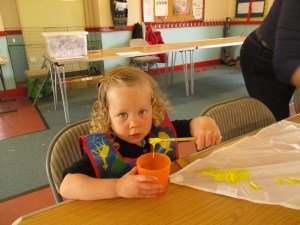
We had a lot of messy creativity going on at the Pentecost Fun Day today – it’s amazing how much of my granddaughter’s body can get painted as well as the thing she is actually trying to paint!


It was lovely to see so many people enjoying the opportunity to be creative. Those of you who know me know I love creativity but hate mess. Paint, glue, glitter and sticky icing are not really my idea of fun – especially when it comes to cleaning up and tidying up! Yet as we took part in the different activities today, they became for me a parable of life.
Life is messy but intensely creative. Things aren’t always neat and orderly. If we want to see masterpieces created, we have to be prepared to get our hands dirty. If we want to serve God in our communities, we have to get our hands dirty. We have to be involved; we have to be there – in people’s mess, in the ruins of their lives, in their heartaches and sorrows as well as in their joys.
Jesus came to earth and got messy. He knew heartache and sorrow, pain and suffering… but still He found joy in life and spread love and laughter wherever He went. I love this idea of ‘messy play’ and ‘messy creativity’, even though I squirm inwardly at messiness. God is a creative God and we’re made in His image. If He doesn’t mind mess, neither should we.
Pentecost Fun Day (2)
It was lovely to be able to enjoy the outdoor facilities at Houghton Road Centre:


We were also kept fit by a game of ‘Pass the Parcel’ with forfeits which included star jumps, press-ups and running on the spot:


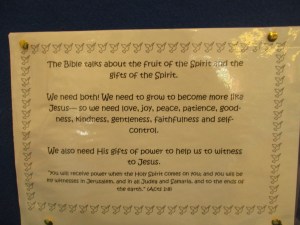
We learned about the fruit of the Spirit through a Pentecost trail and also heard the story of the first Pentecost:


Thanks to everyone who attended and who helped to make this such an enjoyable day.
Pentecost Fun Day
Although the Day of Pentecost is not actually until 9th June this year, we held our Pentecost Fun Day early because of the school holidays. All our craft activities were based on this theme, looking at how the Holy Spirit is described as wind, fire and a dove.
Setting up beforehand:



We had the opportunity to paint and decorate kites (representing the wind of the Spirit) and make prayer plates with tongues of fire:


We decorated buns and enjoyed cutting and sticking:


Ian and Adrian from Dearne Kids helped us cook food outdoors:


Volunteers from the Salvation Army worked tirelessly to feed us food on the theme ‘fire and ice’ – chilli, rice, ratatouille, noodles, with strawberries and cream too!


Many thanks to all the church volunteers who helped, to the HRC committee and to Ian and Adrian from Dearne Kids for their help. Thanks to all who came!