

Be alert!
One of the things Paul tells us about prayer is the need to stay alert. Prayer can be hard work; in the Garden of Gethsemane, Jesus entered into a time of prayer, a time of fellowship, a time of communion with His Father, but He also asked the other disciples to ‘stay here and keep watch with me.’ (Matt 26:38) When He returned to them, He found them sleeping and said, ‘“Couldn’t you men keep watch with me for one hour?” he asked Peter. “Watch and pray so that you will not fall into temptation. The spirit is willing, but the flesh is weak.”’ (Matt 26:40-41)

The Bible exhorts us in many places to wake up and not be asleep (see 1 Thess 5:6-8, Is 52:1, Eph 5:14, Rev 3:2). When I used to invigilate exams, there was a need to stay alert. An invigilator is required to ‘keep watch’ over candidates, but in the peace and quiet of an exam room, with the sun shining through windows, this can be a difficult thing to do. The invigilator has to stay alert and cannot afford to slumber. In the same way, we can’t afford to be sleeping when we should be praying. We need to be disciplined and committed, setting aside time to pray because we know this is our lifeline to God. This may mean getting up a little earlier than ideally we’d like to… spending some time at lunchtime in prayer instead of just reading a newspaper or chatting to colleagues… saving some time at the end of the day for God. It’s surprising how hard it can be to concentrate when we start to pray, but we can overcome this lethargy by taking captive every thought to make it obedient to Christ. (2 Cor 10;5)
.God’s word and prayer are two of the greatest blessings God gives us and also two of the greatest weapons we have. He doesn’t leave us in battles without the right equipment; He gives us everything we need to overcome. The blessings actually become the means to win the battle! As we stay alert, depend on God’s word and rely on prayer, we are enabled to become victorious in the spiritual battles of life.
The Blessing of Prayer
We’ve been looking for some time at the blessings found in the book of Ephesians and today looked at the blessing of prayer (Eph 6:18-20). The armour of God gives us all we need to be protected in the battles of life and the sword of the Spirit and prayer are the spiritual weapons God has given us to be overcomers in these battles. We don’t always view prayer as a blessing, however, often feeling that it is a duty and that it is impossible to pray continually, as we are commanded to do. (1 Thess 5:17) Prayer can very easily become a burden to us, another thing to tick off on a ‘to do’ list that grows ever longer the older we get.
In truth, God never commands us to do something without giving us the resources to do that thing! Praying continually does not mean we do nothing except pray – Paul was a tentmaker and missionary and clearly did lots of things as well as pray! We have to learn to pray in the Spirit, not only having specific times for prayer but also being continually in connection with God. Prayer is like a rope connecting us to God as the climber is connected to the rock or mountain. We can pray with all kinds of prayers and requests; there is no ‘right’ way to pray. Prayer can involve speaking outloud; it can involve praying in silence. It can incorporate praying in other languages as the Spirit gives these to us; it can involve singing. We can pray with groans. We can pray in the morning (Ps 5:3); we can pray in the evening (Matt 14:23); we can pray morning, noon and night (Ps 55:17). What matters is that we are praying on all occasions with all kinds of prayers and requests. (Eph 6:18)
Often, we are reluctant to pray because we feel we don’t know what to pray for or who to pray for. Paul covers these things too! He urges us to pray for God’s people and in many places in his letters shows us how we can pray (see Col 1:9-12, Eph 1:19-21, Eph 3:16-19). We can pray these prayers for other people! Paul asked for prayer for himself to fearlessly make known the mystery of the gospel. This is a great prayer to pray, not only for our leaders and preachers but for each one of us, for we are all called to be witnesses to Jesus.
As we pray in this way, we find we will never run out of inspiration, for God’s word acts as fuel for our prayers and that the Spirit of God will blow fresh wind into our prayer lives so we can learn to overcome and live in communion with God.

Hearing & Heeding
Every time we meet with God, we have an opportunity to hear and to heed Him.
God is a God who loves to speak with us. Samuel learnt to hear God from an early age (1 Sam 3:1-14). One of the names of Jesus is ‘the Word’ (John 1:1-3) and the writer to the Hebrews reminds us that God speaks in many different ways but primarily now through Jesus. (Heb 1:1-3) The problem very often isn’t with God speaking, but with our hearing.
So often, we are so busy that we fail to listen properly. Our lives are cluttered with so many things that we do not hear God speaking. Listening to God requires a slowing down, a deliberate intention to listen to God’s voice and a training of our ears. Just as a mother is alert to the sounds which signify a baby rousing from sleep, so we need to be alert, listening for the gentle whisper of God’s Spirit.
Hearing is not enough of itself, however. We need also to heed God. To heed is to pay attention, to give consideration to. It’s not enough to let God’s words wash over us. We have to ‘pay the most careful attention to what we have heard, so that we do not drift away.’ (Heb 2:1) Ps 107:43 says, ‘Let the one who is wise heed these things and ponder the loving deeds of the Lord.’ Wisdom comes through heeding instruction (Prov 13:1); whoever heeds correction is honoured. (Prov 13:18). If we want to prosper, have understanding and be wise, then we have to learn to heed as well as to hear (see also Prov 15:5, Prov 15:31, Prov 16:20, Provb 28:4).
Hearing and heeding go together and lead to the next crucial stage: obedience (see 1 Sam 15:22). As we hear God speak, heed His words through meditation and contemplation, we can move on to action. God speaks so that by obedience our lives can be realigned with Him and we can become wise. Take note!

Mosaic Creativity
Today we hosted the Dearne Community Arts’ Festival mosaic project. As part of the festival’s remit to champion creativity and celebrate community, a community mosaic is being created which was started today. Artist Ruth Waterworth made a design for us to stick tiles to so that we could create a beautiful mosaic to be displayed at the arts’ festival on 28th September this year.


We had to stick tiles to the picture/ letter outlines:


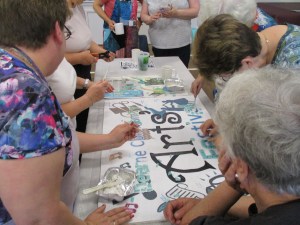


We also had the opportunity to let the children have a go at foam mosaic coasters:


Other local community groups will be taking part in mobile mosaic workshops over the next few weeks, making mosaics which reflect their group’s logo or ethos. The finished mosaic will be displayed at the Dearne Community Arts’ Festival on 28th September at Astrea Academy Dearne.
Reflexive Verbs
A reflexive verb is where the subject of the verb is the same as the object – or, in other words, where the person (subject) doing the action (verb) is the same as the person receiving the action (object). In English, we usually add -self to show this: ‘I wash myself’ means I’m doing the washing and I’m also the one being washed (whereas ‘I wash the car’ means I’m doing the washing, but it’s the car which is being washed!)
When we’re younger, reflexive verbs are beyond us! We’re not capable of washing ourselves, dressing ourselves or feeding ourselves. We need help with the most basic things. We’re passive and have to submit to others doing things for us.
Spiritually, it can be the same thing. When we first enter the journey of faith, we may feel wholly dependent on other people to feed us, direct us and help us. But there will come a time in every Christian’s life when we need to learn to feed ourselves, pray and seek God for ourselves, not relying on other people to do these things for us – however godly they are.
In 1 Sam 29 and 30, we read of difficult times for David. on the run from Saul, whose jealousy has turned to murderous hatred, he has sought refuge from the enemy – and now even the Philistines don’t want him! Frustrated and disappointed, he returns home to Ziklag to find not refuge and sanctuary, a place to lick his wounds in peace, but loss and devastation. Now even his own men turn on him, talking of stoning him as they blame him for their misfortune.
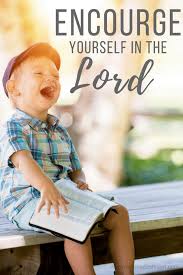
At this point, there is no help to be found externally. It’s time for David to discover the value of reflexive verbs: he ‘encouraged himself in the Lord.’ (1 Sam 30:5) David found the strength he needed in God.
How? How did David move from being weary, discouraged, frustrated man who must have wondered when things were going to g his way to being the victor who would not only recapture all that hadbeen stolen from him but who would show compassion to the weary men who could go no further and mecy to a lost Egyptian?
He encouraged himself. Instead of dwelling on his feelings, lacerating himself with doubt and despair, he fixed his gaze on God. He remembered the promises of God, doubtless reminding himself that God had anointed him, so the story couldn[t’ end here. He meditated on God’s word; he focussed on God’s power and strength instead of bemoaning his situation and the attitude of those around him.
The result of this was a turnaround of circumstances for David. He consulted the priest. He sought God. He mobilised a raiding party. He acted decisively and authoritatively.
Once, on a previous occasion, David had needed the encouragement and reminders of Jonathan to set him on his feed agai. But sometimes God wants us to encourage ourselves. Sometimes there’s no one else there to lift us up. Sometimes it’s just us and God.
And at those times, as we learn to encourage oruselves in the Lord, God is there to lift us up, to send us on our way with a clap on the back and a dose of His endless energy which raised Christ from the dead and is surely enough to raise us too.
Key Points
Preachers are keen to make key points (often using headings or alliteration or other techniques to give people somethng they can easily remember) so that those listening can take hold of what they hear and not let this disappear through their hands like sand.
Peter’s sermon following the healing of a lame man (Acts 3:11-26) has three key points we would do well to remember:
1. Don’t look at us!
2. Look at Jesus!
3. Do Something About What I’ve Said!
We need to ensure that we deflect attention away from us and make sure people are looking at Jesus. Salvation is found in Him alone. We need to learn from Jesus who only did what He saw the Father doing (see John 5:19, 30; John 8:28; John 6:38) As John the Baptist reminds us, He (Jesus) must become greater and we must become less. (John 3:30) It’s only as Jesus is lifted up that men will be drawn to Him (John 12:32). It’s all too easy to talk about church and church activities, but we need to tell people what Jesus has done for each one of us. When God does amazing things, as He did with this healing, we must be careful not to take credit for it, but to give God the glory (Acts 3:12-15)
We must also ensure that people realise there is a consequence to what Jesus has done; there is a response required from each one of us. We are not dealing in historical fact alone or in interesting moral dilemmas. Peter was blunt about the people’s role in the death of Christ and about their need to repent and turn to God. We need to have the same courage so that we make people aware of the need to choose.
