Serving God Where You Are
Many of us live life in a state of frustration and veiled resentment. We feel we could serve God so much more effectively if only something were different in our lives. We long for a different job, perhaps, or for more free time; we feel hampered by our health or hindered by our circumstances and dream of a future date when we will have the time, health and money to serve God without hindrances.
When we read the Bible, however, we see that service occurs in inauspicious circumstances for the most part. A slave girl in Aram speaks God’s word to a commander in the army and as a result he is healed. (2 Kings 5) Daniel serves God in a foreign land to which he’s been hauled as a captive. Ruth serves God in the midst of widowhood and loss. Paul writes letters we’re still reading while he is in prison for the gospel’s sake. None of these circumstances looked ‘favourable’, but all of these people had learned the secret of being thankful and content wherever they were and served God no matter what their circumstances.
Nicky Gumbel says, “Rather than looking to the future when you might be in a better situation to serve God, focus on how you can serve God in the present, whatever your situation.” God’s word urges us to make the most of every opportunity and to be gracious in speech and actions. (Col 4:2-4) This applies to every one of us in every situation. All of us, even the housebound and ill, can pray and thus participate actively in God’s work. Prayer is partnership with God!
Paul asked others to pray for him – not that he be released from the prison (which might have been my prayer in his position!), but that he might proclaim the message of Christ clearly. We can pray for people to do this wherever we are and in so doing can begin to serve God wherever we are.

Out of the Overflow
What’s inside is reflected on the outside. We can’t help but show outwardly what’s going on inwardly. Some of us are better at hiding our feelings than others, but in the end, our thoughts, speech and behaviour find a way out!
Every day reveals our heart to others. Do we lie? Slander others? Rage and explode? Do colleagues and family dread being with us because of our volatility or negativity? Is our language coarse or profane?
People’s Facebook pages give us an interesting mirror into the inward, since what is posted there is often a reflection of true feelings (at the time of posting, anyway!)
Paul urges us to live differently (Eph 4:17-32, Col 3:1-17). Each morning we have the choice of what clothes to put on. Paul urges us to clothe ourselves with compassion, kindness, humility, gentleness and patience. (Col 3:12) I think of each of these as a garment to put on. Just as I can choose what to wear each morning, I can choose whether I let the new life of Christ shine through or live in the old way.
Clothes are an external covering, an adornment. Ultimately, we can’t live the life of Christ as an add-on extra. His life grows from within, from our union with Him. What’s in our hearts will manifest itself in how we think, speak and behave. So ponder what you’re saying to yourself, saying to others and doing. Ponder what you post on social media before you use it as a platform to rant, criticise and bring others down. Ponder how you’re interacting with others. What’s on the outside reflects what’s on the inside. Only people clothed in Christ can impact the world as Christ did.

Walking With God
Tonight’s ‘Little Big Church’ looked at the subject of following Jesus. If we’re going to go for a walk, good shoes that fit are generally considered essential, and walking with Jesus is one of the ways we can describe being a Christian. Jesus asked people to follow Him (e.g. calling Matthew from his job as a tax-collector (Matthew 9:9) or calling Simon and the other fisherman from their jobs into a new vocation (Luke 5:1-11)).
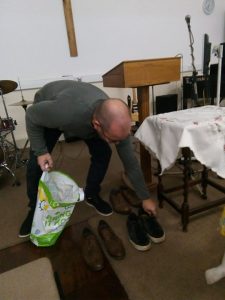
Following Jesus might seem a little scary; His shoes are big to fill, as the saying goes! The children had a go at walking in Stephen’s shoes and found it wasn’t as easy as walking in their own:

Not everyone whom Jesus called decided to follow Him. The rich young ruler didn’t want to give up his wealth to follow Jesus (Matt 19:16-20) and we can be easily distracted by possessions and other things which stop us from following Jesus. Sometimes, we feel that walking with Jesus is a little bit lonely – rather like the person in the ‘Footprints’ poem who, when seeing only one set of footprints in the sand, assumed God had deserted them, rather than realising it was at those times that God carried them. As Moses reminded the Israelites, ‘There you saw how the Lord your God carried you, as a father carries his son.’ (Deut 1:31) God is able to carry us when the going gets tough and in the meantime, we can walk with God every day of our lives.
Because You Say So
Dave spoke this morning from Luke 5:1-11. Here, we see four fishermen having ‘one of those days’, a time when nothing seemed to be going right for them. They had been fishing all night and had caught nothing, and for men who made a living from fishing, this was no small problem. Jesus was preaching and used Peter’s boat to be able to address the crowd; then, when the crowd had dispersed, He (a landlubber and carpenter by trade!) gave them advice on where and when to fish!
There must have been a sense of weariness and cynicism in the four fishermen on hearing this command. They must have thought ‘what’s the point?’ They felt frustrated and inadequate, having not caught any fish all night, and when we have failed so often, it’s really hard to risk failure one more time. Yet because he was obedient, Peter agreed to this apparently madcap scheme, only to catch such a large haul of fish that the nets began to break and the boats began to sink!
Peter’s response (‘But because you say so, I will let down the nets‘) reminds us that we need to do what Jesus tells us, however much His words seem to contradict our knowledge, wisdom and understanding. God wants to give us abundant life (John 10:10) and His abundance can come from nothing and from nowhere. We need to understand that when we obey what God says, His grace to us is not without effect. (1 Cor 15:10) If we do what He says when He says, we will see amazing things in our lives.

October notices
There are some interesting things happening in October locally, so here are some dates for the diary.
From 14th October, a local group called B:friend is hiring the community room at our church for meetings between 1.30 and 2.30 p.m. This organisation seeks to link people with those who are elderly and unable to get out and about and to tackle loneliness in our area. Come along to find out how you can be a befriender and make a difference in our community.

The Christian Institute is holding a meeting entitled ‘Living Christianity’ at Bessacarr Evangelical Church on Bessacarr Lane in Doncaster on Monday 14th October at 7.45 p.m. This meeting looks at issues that are very much in the news at present such as the family, gospel freedom and gender ideology and discusses the Christian response to government legislation.

We hold midweek meetings on Thursdays at 7.30 p.m. to study the book of Acts and to pray. There will be no Thursday meeting on 17th October, but instead there will be a prayer meeting on Friday 18th October at 11.30 a.m.

The ‘Churches Together’ prayer meeting in October will be on Wednesday 23rd October at 10.30 a.m. at GPCC. Join with us to pray with Christians from other churches.
Don’t forget our main outreach event on Wednesday 30th October at three local venues: Houghton Road Centre in Thurnscoe (9-11 a.m.), GPCC in Goldthorpe (12-2 p.m.) and St Andrew’s Parish Hall in Bolton-on-Dearne (3-5 p.m.) when we will be welcoming the Message Bus to our area and hosting a Family Fun Day in each of these venues with crafts and activities on the theme of light. Please pray for the organisation of this event and let Julie know if you can help in any way at any of these venues.

“You’re a born….”
Sometimes people will say about a person ‘he’s a born leader’ or ‘she’s a born teacher’. What they mean by this phrase is that the person seems effortlessly good at doing those things so that it is as if there has never been a time when they were not doing them.