

August news
We are busy preparing to re-open our building for services on 2nd August. Things will look different, as we have spaced chairs out in family bubbles and for individuals to maintain social distancing, as required by government guidance.


There are new notices, reminding us of the need to practise social distancing both inside and outside the building and to wash hands and use hand sanitiser regularly.

Despite the restrictions, we are very much looking forward to meeting again in person and services on 2nd August will be at the usual times of 10:30 a.m. and 6:00 p.m. The morning service will involve Holy Communion and you are asked to bring your own bread/ fruit juice to avoid cross-contamination through handling these items. Because of the potential risks handling refreshments, we won’t be serving drinks after services at present.
We hope to run Sunday services and meetings on Thursdays (at the usual time of 7:30 p.m.) in the building, but will also be livestreaming Sunday services on Facebook live from the GPCC Facebook page to give all who cannot attend in person the opportunity to join with us in services.
On Wednesday12th August there will be a ‘Dearne Churches Together’ prayer meeting at Furlong Road Methodist Church at 10.45 a.m. (also livestreamed from the DCT Facebook Page.) Join us to pray for God’s healing for the world and stay for a picnic (bring your own food and drink!) if you can. All being well, we will meet outdoors and social distancing will be in place, but we can’t wait to actually connect in person after so many months apart!

Miracles
Stephen spoke tonight on the subject of miracles, asking if they are relevant, possible and real today? He challenged us to consider two statements:
-
God is who He says He is
-
God can do what He says He can do
Many of us accept the first statement but struggle more with the second, largely because we doubt ourselves and wonder if God will really do what He says for us. When we consider who God is, we see that His names both reveal His identity and what He does. He is the Saviour – He saves. He is the Deliverer – He delivers. He is the Redeemer – He redeems. He is the Master – He is the boss. He is the Bread of Life who provides for us, the Almighty One who exerts divine strength, the Alpha and Omega. (Rev 1:8) This is who God is, but so often we stop at this point, failing to realise that God can do immeasurably more than all we ask or imagine. (Eph 3:20-21)
Heb 11:1 gives us a definition of faith which talks of confidence and assurance. The more confidence we have in God, the more likely we are to believe He is able to do what He says He can do. So often, our faith is lacking, as we feel we are not ‘good enough’ to have God do miracles through us. But faith is the vital ingredient, for miracles happen when God works. He is the One who does the miracle; we just need faith as small as a mustard seed to see great things happen. (Matt 17:20)
God wants to do miracles through us. Jesus the Miracle-worker is with us; His power is available to each one of us and no word from God will ever fail. (Luke 1:37) We are called to speak the ‘Amen’ of faith (2 Cor 1:20); Jesus is the ‘Yes’ man! We need to see with the eyes of faith (maybe we need to put ‘miracle glasses‘ on!) and understand that Jesus is the ‘Man Who Can‘! Just as athletes have to train hard to build up the muscle strength they need, we need to train our muscle of faith so that our faith can erupt like a volcano. Through faith in an almighty God, all things are possible.

Expectation & Fulfilment
Garry continued his series on words associated with ‘Sabbath’ this morning, looking at two Hebrew words which are connected to expectation and hope and then to fulfilment and satisfaction, both crucial aspects of our gathering together when we keep the Sabbath.

‘Seber‘ means to put under close scrutiny and examine and from this leads to the idea of hope and expectation. We find this in Esther 9:1, when the officials who had plotted against the Jews were expecting or hoping for the king’s edict to be carried out. (It wasn’t, because of God’s intervention!) The idea of hoping and expecting is also closely connected to waiting (see Ps 119:166, when the psalmist talks of waiting for God’s salvation). When we gather together, we re-focus and put our hope in God, but so often, our expectations are not met because we have wrong ideas about God and the ways He works (as exemplified by Job’s comforters, who persistently said that his suffering was as a result of his sin, which was not the case at all.) Ps 34 reflects how we can taste and see that God is good, how our spiritual experience leads to spiritual knowledge and how we long for this to be shared by others. As we align ourselves with who God is and the ways He works (understanding the difference between ‘the God we want and the God who is’, as Casting Crowns put it), we find that He brings us satisfaction. Our gathering together, therefore, must involve anticipation, hope and expectation (see Ps 42:1-2), but these must be mingled with faith (Heb 11:6).
What can we expect, then, when we meet with God? We can expect:
-
God to speak to us (through preaching, praise, prophecy, tongues, interpretation, words of knowledge and wisdom)
-
God to move in power by His Spirit
-
God to convict, encourage and enlighten
We find satisfaction and fulfilment in God (the Hebrew word is ‘saba’ and means to be filled to overflowing, as the Israelites experienced in the wilderness in Ex 16:6-11.) The psalms often speak of this satisfaction (Ps 63:5, Ps 65:4) and Paul tells the Romans ‘May the God of hope fill you with all joy and peace as you trust in him, so that you may overflow with hope by the power of the Holy Spirit.’ (Rom 15:13) As we put our hope in God and understand who He is, we find He keeps His promises and is completely faithful, reliable and trustworthy. Our souls are satisfied and we find that in God, we can stand firm on His promises and know fulfilment in every area of life.

The Long View
Christianity is concerned with the now. The now is all we have; as someone has once said, playing on the synonyms ‘gift’ and ‘present’ and on the dual use of the word ‘present’ in the English language (where it can mean both ‘gift’ and ‘the moment now’), ‘the present is God’s gift to us.’

We are urged not to worry about tomorrow but to live in the moment, rejoicing in all God does for us. Living in the past, haunted by past failures or clinging to past blessings, is not God’s plan for us. Living in the future, fearful of what might happen or dreaming contentedly of how we will shape our world, is also not helpful. The now is the only moment we truly have, a moment we are to seize joyfully and gladly. ‘Let us rejoice and be glad!’ (Ps 118:24)

But Christianity is not only concerned with the now. It acknowledges the need to remember the past (especially what God has done – see 1 Chron 16:12) and to anticipate the future with hope and joy. Christianity has a God who is eternal, who has no beginning and no end and He has made us with eternity in our hearts. (Eccl 3:11) We need to live with an awareness of eternity, not just time!
So Christians are called to live with our eyes fixed on Jesus and to take the long view.

Living in the ‘now’ only makes sense when you have the assurance of eternity. Injustice now is only bearable with the assurance of God’s righteousness at some point. Suffering now is only bearable with the assurance of God’s perfect eternal rest. Without this long-term perspective, the present can crush us and leave us in despair and hopeless.
God’s people have faced tremendous suffering in the past – slavery in Egypt, exile from the promised land, periods of darkness and silence. Hope is the medicine that keeps us going through our ‘light and momentary troubles’ to the ‘glory that far outweighs’ the suffering (2 Cor 4:17-18, Rom 8:18). Michael Card once wrote that we ‘belong to eternity, stranded in time.’ (‘Joy In The Journey’) That is a fair summary of the paradox to which we are called: to live in the now with faith and trust, but always to take the long view.
Jeremiah could face exile knowing there would be a return to the field he had just bought in faith (Jer 29-32). Amos could face exile knowing there would be a time of return. (Amos 9:13-15) Jesus could face the cross because He could look ahead to the joy of bringing salvation to all who would call on His name. (Heb 12:1-3)
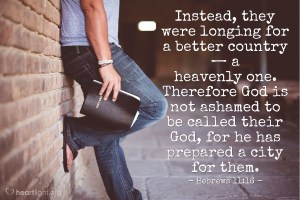
If you’re struggling with your present – perhaps finding it difficult, lonely, bewildering and definitely not what you’d expected – remember to hold on in faith. Keep the long view. Don’t give up. The present may be all we have, but we belong to eternity and are still looking ahead to the eternal city promised by God. (Heb 11).
Questions and Answers
The book of Job has 42 chapters and tackles the universal question of why the innocent suffer. It debunks the notion that cause and effect are inevitably at the heart of suffering (‘we suffer because we sin’), and throughout the book we see different people struggling and wrestling as they try to process this question of human suffering and how a good God can allow so much misery and pain. Job and his friends think at times they have the answers, but working out the ‘mechanics’ of God will always be beyond us. We, the readers, have had a glimpse behind the scenes in Job 1, but even that does not fully answer all our questions.

It’s not until Job 38 that we find God appearing to Job, and even then, it’s not with neatly packaged answers, but with impossible questions. Confronted with God’s awesome power and omniscience and unable to answer His questions, Job can only bow before God in repentance and faith. He can only worship.

Michael Card said, ‘Could it be that questions tell us more than answers ever do?’ (‘Could It Be?‘) Answers are what we seek from God so often. But answers are sometimes beyond our understanding and leave us at a distance still. Questions invite us further into our relationship with God, into struggling and wrestling perhaps, but into a deeper intimacy and personal relationship.
The questions God ask Job remind us of the wonder and majesty of God. They look beyond our questions (which are usually bound up in our own lives and limited understanding) and remind us not only of the ‘bigger question’ but of the bigness of God Himself.
I find it interesting that the book of Job does not answer our questions, but instead introduces us to God’s. Life is about more than knowing all the answers. Life is about worship and wonder, about the transcendence of God and about our own insignificance in so many ways. Yet God loves us so much that He communicates with us and seeks to draw us further into this amazing relationship with Him. As Rend Collective sing,
“Jesus, One and only
Great and holy, we are Yours.
How our hearts race at Your glory;
Lord Almighty, we are Yours and Yours alone.’ (‘One And Only’, Rend Collective)
Questions and answers both pale into insignificance when we are confronted by the sheer awesomeness of God, when we glimpse His holiness and power. We’re only left with worship as our appropriate response.
Developing A Growth Mindset
In our ‘Churches Together‘ meeting today, we looked at developing a growth mindset. Developing a growth mindset means we commit ourselves to growing, which means:
-
embracing new challenges (instead of running away from them)
-
developing perseverance (instead of giving up easily)
-
being kind to ourselves (rather than always being critical of ourselves)
-
learning from criticism (instead of being crushed by it)
-
seeing life as a journey that’s worth the effort (instead of believing life is pointless)
-
being inspired by other people’s successes (rather than being put off by them)
-
helping and nurturing other people (instead of always criticising or judging them)
-
believing that with God, nothing is impossible (instead of always looking at limitations)
We believe that God wants to work in our lives to bring us to maturity in Christ (Eph 4:15-16, Rom 8:29) and that for us to become mature means being willing to change and to grow. Often, this involves challenging our wrong thinking and allowing our minds to be renewed and our thinking to be transformed. (Rom 12:1-2) It’s a process (rather than a one-off event) and takes our commitment and determination. We have to learn to ‘think outside the box’ and do things differently… which can be terrifying for cautious, risk-averse people, but ‘with God, nothing is impossible.’ (Luke 1:37)
