

Lessons from the Life of Joshua
Tonight we continued looking at the lessons we learn from the life of Joshua and in particular focussed on the victory God brought about in miraculous ways at Jericho. (Josh 6:1-25) Victory at Jericho, the first town to fall in the Promised Land, demonstrated God’s power over all the nations, but it was definitely an unusual divine strategy which led to this victory. The people of God were commanded to march around the city for six days, and then on the seventh day, march around seven times, with the priests blowing the trumpets. This would lead to the walls collapsing and then the army could go in and bring about victory.
We see how the people’s obedience was instrumental in this victory, but ultimately also how God used ordinary means – trumpets, marching, shouting – to bring about something totally miraculous. The book of Joshua shows us many different victories, each one the response of Joshua to God’s specific word (using ambush at Ai (Josh 8:1-29) or surprise – with an extended day thrown in! – against the five kings of the Amorites. (Josh 10:1-15)) When we have no clue what to do, our eyes must be on God (as Jehoshaphat discovered in another battle years later. (2 Chron 20:1-17))
Methodology and strategy may change according to the times, but the battle belongs to the Lord alone; victory must be His. If we try to claim credit (as Nebuchadnezzar foolishly did in Daniel 4:30-32), the result will be disaster. Humility is necessary if we are to see the miraculous (Luke 14:11). Faithful obedience, such as was demonstrated by Joshua throughout his life, can achieve spectacular results, even if we feel that the means God uses are pretty ordinary!

Grim For The Brothers
Garry spoke this morning from Genesis 42:14-24, which narrates the response of Joseph’s brothers when they finally meet Joseph again after so many years and realise who he is. They obviously had regrets about what they had done and had had to learn to live with their wrongdoing, but clearly, they had not forgotten or totally got over what they had done.
Regret – a feeling of sadness or disappointment over something that we did or failed to do – can develop into remorse (a deep regret or guilt).Remorse is generally more intense than regret. We have to learn that there are different ways to deal with regret. If there is nothing we can do about the situation, we must allow God and time to heal us as we let go of the past. Regrets can be teaching lessons for us, so that we do not continually make the same msitakes. But sometimes we can do something to make amends and need to do that so as to heal fully. Whilst God forgives completely and gives us a fresh start, other people may not.
Regret and remorse have to be dealt with by repentance. Joseph’s brothers were frozen in regret, it seems.They had not yet progressed from remorse to repentance. Reuben clearly remembered how he had tried to rescue Joseph from the brothers’ scheme; this was eating away at him. Joseph, it seems, had moved on in many ways, but even so, when he met his brothers face to face, great emotions were stirred up in him. There is a big difference between forgiving and forgetting. He had not forgotten what had been done to him, but he wrestled with God to the place of forgiveness. Forgiveness is always costly and never easy, but Jesus demonstrates for us both the pain and anguish of forgiveness and the benefits which come from it. Joseph did not have this great example before him, but he learned to forgive.We too need to be people who let go of all that has gone before and move forward with forgiveness into freedom. We are commanded to forgive as we have been forgiven; there is no greater way.

Riding The Waves
I’ve just returned from a holiday in Cornwall where I watched my five-year-old granddaughter have her first surf lesson.

Surfing is all about ‘riding the waves’; surfers stand on a surf board and glide across the water until the wave breaks and loses its energy. What is impressive about watching surfers is how they manage to stand upright and balance on what is essentially an unstable surface. They start by doing this on the more stable surface of the sand before taking the board out to sea. Most people find it easy enough to stand on a board on the sand; standing in moving water requires practice, dexterity and balance.
What impressed me most about my granddaughter was her enthusiasm and perseverance. She couldn’t stand up straightaway. At times, she fell off into the sea. But she carried on, undaunted, and on the occasions when she managed to ride to shore still upright, the beam on her face was all we needed to know about the power of accomplishment!


It didn’t seem to matter to her how many times she fell off in the process; she simply got back up and had another go.
That is a parable for life. We fall and fail many times, but failure is no reason to give up. God wants us to get up and have another go. He pulls us up by the hand and encourages us to try again. Every time my granddaughter did well, the instructor gave her a ‘high five’, encouraging smiles and lots of praise. Every time she failed, he was there at her side, encouraging her on by name.
What a picture of life! We have God’s Holy Spirit within us, urging us on, encouraging us, moving us forward, picking us up when we fail, helping us. We stood on the shore cheering her on, shouting encouragement and clapping when she did well; we have other Christians alongside us, also urging us on and picking us up when we fall. (Heb 12:1-3)
So ride the waves of life. Don’t worry if you fall and get wet. Get back on that surfboard and relish the challenges of life, because you were made to surf!
Bounce Into Summer
Dearne Churches Together and Dearne Community Arts’ Festival were both at the Bounce Into Summer event in Goldthorpe, organised by Goldthorpe Development Group. The event featured a wide range of inflatables, donkey rides, birds of prey, the police with vintage vehidcles, local groups and face painting.


We were involved in craft activities and a map activity, finding out where people lived and getting self-oortraits for a picture map.
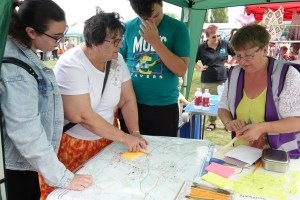


DCAF raised £122 for the arts’ festival through a Hook-A-Duck game. Our thanks to all who helped and to those who joined in all these activities.

Lingering In God’s Presence
Joshua succeeded ultimately because he learned to hear God’s commands and to obey them. Before the victories in Canaan, he had learned to linger in God’s presence. (Ex 33:11) He learned to wait for God’s instructions (his encounter with the commander of the army of the Lord was critical for providing him with the strategy he needed to take Jericho, as Joshua 5 & 6 make plain.)
There is never a substitute for time spent in God’s presence. These times may well seem ‘ordinary’ to us (we may not feel transformed from our regular times of prayer or feel God speaks to us each time we meet with him), but as we discipline ourselves to set time aside, to read God’s word, to listen for His voice (see John 10), we are given the blueprints we need to achieve the miraculous. Time spent with God is the single most important factor in whether we will ever see the miraculous in our own lives, for it is here, in our own ‘tabernacle trysts’, that we encounter the Divine and are led by the Spirit.
Each generation must experience the miracles of God for themselves. The rest of the people of Israel had only heard about the parting of the Red Sea. Only Joshua and Caleb among them had actually witnessed that miraacle. But as the River Jordan parted for them, they saw God work personally for them and their faith rose (Joshua 3) We need to move from the academic (a head knowledge that God is able to do miracles) to the personal (that He will do miracles for us. Miracles underline for us that God is real and that He works on behalf of His people. We pray with the psalmist, ‘Summon Your power, God; show us Your strength, our God, as You have done before.’ (Ps 68:28)

Lessons from the Life of Joshua
