Peter
Garry started a character study looking at the apostle Peter this Sunday evening. Peter is the disciple mentioned in all 4 Gospel accounts about whom the most information is given; highly vocal, often impetuous, his life is one with which we easily identify.
Garry looked at Peter’s first meetings with Jesus and how he gradually became aware of who Jesus was. His was a gradual dawning of understanding: first, his brother (Andrew) introduced him to ‘the Messiah’ (John 1:41), but even after he had witnessed miracles of healing, he was still more interested in cleaning his fishing nets than in listening to Jesus’s teaching. Only after the miraculous catch of fish recorded in Luke 5 does Peter become aware of his own sinfulness in relation to who Jesus is and hears the call of Jesus to give up his life as a fisherman to become a ‘fisher of men’.
All of us, at some point, face that moment of decision, when we either heed the call of Jesus or walk away. Some (like the rich young ruler) choose to walk away. Peter chose to follow Jesus. May we too learn what it means to put Jesus at the centre of our lives and follow Him whole-heartedly.
The power of the Word
This Sunday morning we were not at GPCC… we were visiting Steve and went to his church, Holy Trinity Platt, in Manchester. Steve James, the rector there, preached from Mark 4 on the parable of the sower, the sermon being entitled “The Seed of the Kingdom”.
Jesus’s strategy for spreading the good news when faced with the hard ground of those who were hostile to him or those who were fickle was to talk about sowing seed – apparently a sermon on agriculture! The seed in the parable, the Word of God, has immense creative and recreative power – not the ‘mechanical’ power of outward conformity to religion, but the ‘organic’ power of spiritual life. The Word works by going in deep. The four different types of soil described in the parable – which Steve likened to the four different audiences who heard the message, namely the Pharisees, the crowds, Jesus’s family and his disciples – determine, to some degree, the effectiveness of the seed in that environment.
Jesus taught in parables to challenge us to seek Him. Parables are not obvious; they are a little like riddles and require us to come to Jesus for clarification and understanding. If we come with the attitude of ‘I don’t want to understand… I don’t want to believe’, we run the risk of being unable to believe, rather like Uncle Andrew in C.S. Lewis’s story ‘The Magician’s Nephew’ who, although recognising that Aslan’s creation song was, in fact, a song, disliked it so much that he pretended it was not a song, just the ordinary growl of a lion, until eventually he did “hear nothing but roaring in Aslan’s song.” (see also John 12:37-40). If, on the other hand, we seek God, we will find Him. (Matt 7:7-8)
May we know the power of God’s Word in our lives and constantly seek Him for understanding, that we may see in our lives the fruit of this powerful seed.
Ephesians 6
We finished the Bible study on Ephesians this week by looking at Ephesians 6. Famous for its passage on the armour of God, this chapter has much to say about Christian conduct as well as Christian conflict, with Paul finishing with closing comments to the church.
Christian Conduct
The first verses continue looking at relationships. The submission discussed in Chapter 5 continues by looking at the relationship between children and parents and between slaves and masters (or, in a more modern context, the wider relationship between employees and employers.) Equal value doesn’t necessarily mean equal roles, but the key here is the mutual respect which results from submission to God.
We looked at the limits of obedience (‘in the Lord’) and at the meaning of words such as ‘honour’, ‘exasperate’ and ‘training and instruction in the Lord’. Parents should not be dominated by their children, nor should children be dominated by their parents – love and respect have to be the motivating forces. In an increasingly secular society, the role of parents in teaching and leading by example can never be underestimated; moreover, this teaching should be as much by example and lifestyle as by words.
Similarly, in a work context, whether we are subordinate or in a position of authority, we should work honestly and treat people with respect because ultimately we are all working for the Lord. There really is no such thing as a ‘sacred’ job compared to a ‘secular’ one: all we do is unto the Lord and God has prepared works for each one of us to do.
Christian Conflict
The conflict all Christians are engaged in is real and is not just for zealots. We are all involved, whether we like it or not – maybe not as ‘front line soldiers’, but as Dave reminded us, in the Second World War, even civilians were engaged in working to help the war effort and were attacked by the enemy. This war is not like the ‘Cold War’ where weapons were stockpiled but never used; God equips us with weapons because we need these weapons to be able to stand against the enemy!
The enemy is not people. We have a spiritual enemy who has both strengths and weaknesses, but we have a God who has won the victory and who has equipped us to stand firm.
Closing Comments
The final verses show us that Paul requested prayer for himself (to make known the mystery of the gospel fearlessly… if even the apostle knew fear, then we certainly need to pray for ourselves and others to be given the words to speak out boldly!) and that prayer is something we are called to do all the time – living prayer, constant communion, ‘practising the presence of God’ in all situations. We also looked at Paul’s final words and realised that if we have peace, love, faith and grace, we have all that we need.
Be filled with the Spirit
Dave started the Christmas readings early (Luke 1:11-17), but the need for all Christians to be filled with the Spirit is not something that is limited to one particular time of the year. We all need the Spirit’s infilling to be successful in the tasks God has for us – even Jesus ministered on earth in the power of the Spirit.
If we are to radically affect our neighbourhood, we need the same power that Elijah and John the Baptist knew. In the Old Testament, the Holy Spirit would come upon certain individuals at set times, but now Joel’s prophecy has been fulfilled and the Holy Spirit has come upon all believers. In order to be filled with the Spirit, we must:
1) desire to be filled with the glory of God – not simply so as to receive joy, power or gifts (though God gives all these things) but as that we may glorify God in all we do
2) be clean vessels, cleansed through the blood of Jesus Christ
3) be prepared to let the Holy Spirit have His way, learning to trust Him in everything and learning to surrender our whole lives to Him
4) receive Him by faith
Uncomfortable truth
There are times when God’s Word pierces our way of thinking and we realise afresh just how radical the Gospel is. Sunday morning was one such example of this, as Dave preached from Luke 6:27-38.
It’s easy to gloss over these verses with the contempt of familiarity, but if we are honest, Jesus’s command to “Love your enemies, do good to those who hate you, bless those who curse you, pray for those who mistreat you. If someone strikes you on one cheek, turn to him the other also. If someone takes your cloak, do not stop him from taking your tunic. Give to everyone who asks you, and if anyone takes what belongs to you, do not demand it back. Do to others as you would have them do to you” (Luke 6:27-31) does not sit easily with our fallen natures.
In the 1960s, Martin Luther King spoke out against racial inequality and was hated for doing so. On one occasion, his house was burned down by a group of white men who didn’t like his message and it would have been all too easy for the blacks he represented to retaliate in like manner. Martin Luther King wanted, however, for racial equality to be won through peaceful means. He knew what it meant to love his enemies and to do good to those who mistreated him.
The natural human response to those who hate us and mistreat us is to ‘get our own backs’ but this is not the response Jesus is calling for here. Revenge may look great on the cinema screen, but it is usually as harmful to ourselves as it is to those on whom we practise.
God’s way of doing things is different. We are called to consider others. We are called to love our enemies and to bless those who curse us, to do good to those who mistreat us. We are called to be imitators of God, His representatives and His ambassadors on this earth.
How do we do this? It’s certainly not easy. It’s not a response we are going to naturally feel. But perhaps we need to understand that the choices we face in life are just that: choices. It’s not all about feelings.
Love is the decision to do right, even when you have been wronged; to do good, even bad is done to you; to bless, even when you are cursed; to forgive, even when you are condemned; to care, even when you are not cared for.
Love is not what we feel. Rather, it is the good we decide to do and then go on to do. We may do it with reluctance; we may do it with tears; but we do it because we are convinced that God’s way of doing things is better than our fallen way of dealing with people.
The ‘Golden Rule’ says ‘Do to others as you would have them do to you’. This is a very simple and basic way of determining how we ought to act towards others. It’s also linked to the principle ‘the judgment you give is the judgment you will receive’. We need to forgive, because we ourselves need lots of forgiveness. We need to bless, because we need God’s blessing. And as we love our enemies, so love, rather than revenge, will come back to us. What we sow, we will definitely reap.
Moreoever, if we still feel that this way of living is beyond us – and we can only do it with God’s help and through His grace – then as always we have the example of Jesus to show us that it is, indeed, possible:
“Christ suffered for you, leaving you an example, that you should follow in his steps.’He committed no sin,and no deceit was found in his mouth.’ When they hurled their insults at him, he did not retaliate; when he suffered, he made no threats. Instead, he entrusted himself to him who judges justly. He himself bore our sins in his body on the tree, so that we might die to sins and live for righteousness; by his wounds you have been healed. For you were like sheep going astray, but now you have returned to the Shepherd and Overseer of your souls.” (1 Peter 2:21-25)
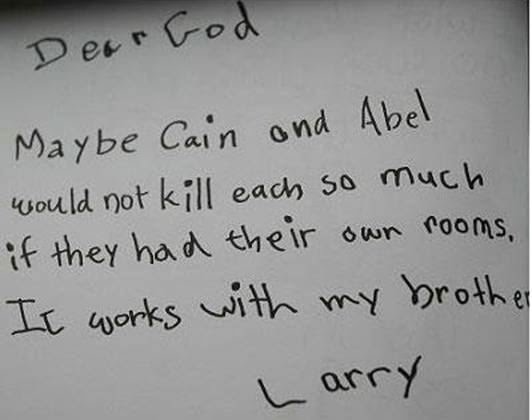
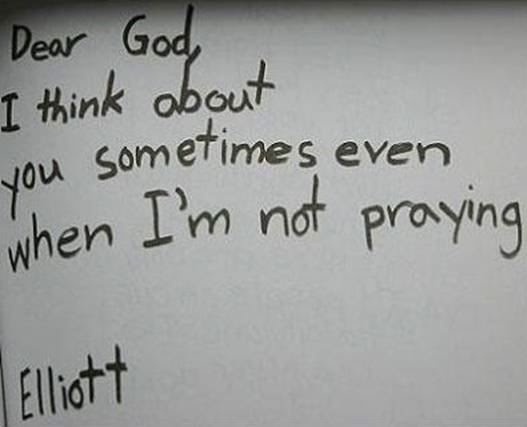
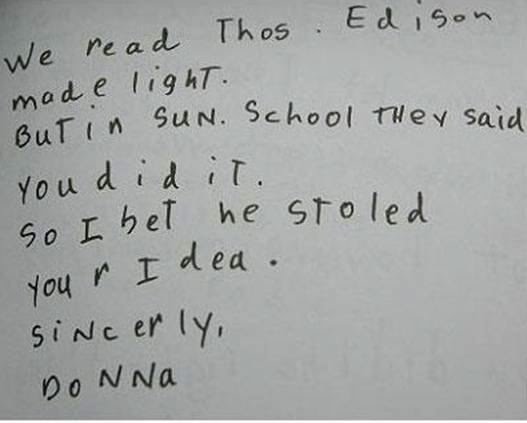
Out of the mouths of babes…
I was sent these comments this week and loved them, so I thought I would share them with you all! I don’t know the original source of the comments, but as always, children have a great perspective on life!