

January news
Hard though it is to believe, we’ve finally arrived at 2015! For many, today is the first day at work of the New Year when life slowly gets back to normal after the holiday festivities.
Our first family service of the year is on 4th January, looking at the theme of ‘Signposts and Directions.’ We are praying for God’s guidance throughout this month, particularly for:
- open ears and open hearts to hear God’s Spirit leading and guiding us in our everyday lives
- obedience to respond to everything God tells us to do
- God to speak into people’s lives and situations, bringing dreams to fulfilment and working all things together for good
- God’s help in listening to Him daily
- church leaders to be attentive to and responsive to God’s promptings and for all of us to work together in following God whole-heartedly
- unity and love to grow in our church and in all the other local churches
As usual, we will be holding a short service at Cherry Tree Court, Highgate on the 2nd Sunday morning of each month (starting at 10.30 a.m.) and so there is no service at Market Street on 11th January in the morning. Sunday evening services throughout January start at 6 p.m.
The first ‘Churches Together’ meeting of the year will be on Saturday 17th January at 7 p.m. at Furlong Road Methodist Church, Bolton-on-Dearne. Celebrating the week of Christian unity, this will be a great time of prayer, praise, fellowship and teaching, so do come along to that if you can.
More party games
Some of the party games devised by Mark are not quite what you’d expect, however!
The adult version of ‘Musical Chairs’ involves the men getting women to sit on their knees when the music stops and vice versa for the women’s round! These photos show the mad scramble to find a suitable adult! Herlen won the ladies’ round and Tony the men’s.


 This version of ‘Pass the Parcel’ involved lots of silly hats and clothes and forfeits, one of which included singing ‘Silent Night’:


 This game involved a stuffed chicken and lots of silly noises…


 Other games involved silly challenges, including a ‘staring contest’ (won by Stuart):
 … a space hopper race full of sibling rivalry:
 … and a paper aeroplane challenge, where the mechanical engineer (Garry) was proud to beat the civil engineer (JP)!
All in all, a hugely entertaining (and exhausting!) party, with many thanks to Mark for his ingenuity and cunning!
 … to Garry and Alan for their photos:

 … to all who helped with the food preparation and clearing away:
 … and to all of you who attended!
Party games
Some of the party games played at the New Year’s Day party were quite ordinary… men vs women in ‘Charades’, for example:


 … or ‘Musical Chairs’ for children:

 In this game, when the music stopped, you had to pretend to be Santa or a Christmas tree or a reindeer:

 Not all the games were this straightforward, however!
Party celebrations
The New Year’s Day party at church is a great opportunity to see the diversity of church in action. We got to celebrate with a special birthday cake:
 … but as usual, there was lots of other food as well!

 Everyone has the chance to catch up with friends and family:


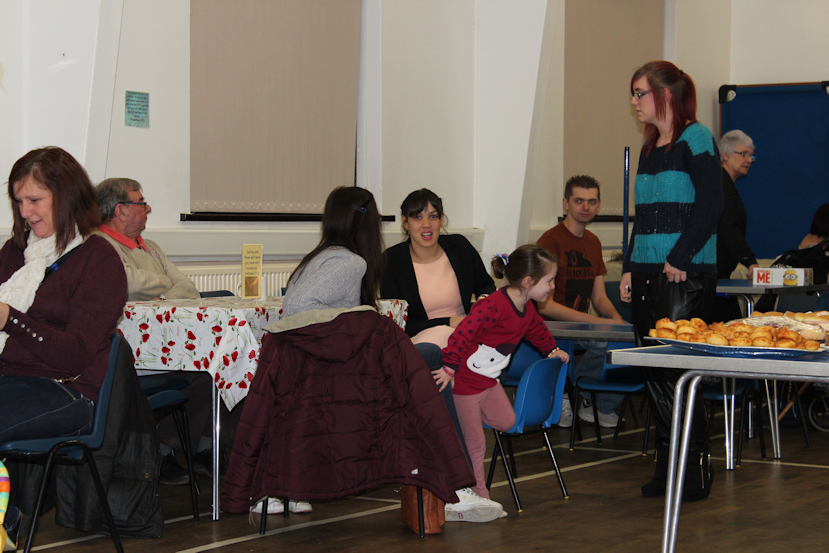

The age range of our church is great, which makes for a lot of fun on these occasions!


 After the food, there were party games…
Death by sugar…?!
It’s something of a family tradition that my father buys me something to do with cooking for Christmas. Over the years, he’s bought me a milk frother, a juicer, a tagine and a yogurt maker: in fact, a casual glance in my kitchen cupboards will probably tell the story of Christmas in a rather unusual way! This year was no different, and he bought me a set of cake tins which form a tall, tower cake along with various colourings, icing and decorations.
 Armed with these presents, I decided I would bake a rainbow (-ish) cake for the church New Year’s Day party. Whilst being nowhere near as beautiful as the pictures on the cake tin box or recipe book, this cake is at least coloured on the inside (honestly, Dave & Mark!)
 The finished product again is not quite as even or pristine as I would like, but for a first attempt, it’s not that bad, even if it does look rather lopsided!
 However, based on the amount of sugar in the cakes, the marzipan between layers and the icing all over the cake, I have to warn everyone that this is definitely not a healthy eating option! Having said that, I hope it is enjoyed by all who come to the party, which starts at 4 p.m. on New Year’s Day.
Now on to the chocolate fudge cake!!
For all that You have done
I have never quite got the hang of New Year’s Eve or New Year’s resolutions. I can understand the point of marking dates and remembering special occasions, but the world’s way of celebrating, with copious amounts of alcohol immediately followed by pious resolutions to be more virtuous, exercise more and lose weight seems strangely warped to me. As one person has said of contemplative personalities, ‘We assess and reassess our feelings, attitudes, responses and actions on a daily basis, maybe hourly, perhaps every ten minutes and sometimes in the same thought and on either side of a doughnut! Why would we throw another tractor tyre onto the pile for our personal Strongest Man competition?’
One of the greatest sources of my confusion lies with the Scottish traditions of Hogmanay. First-footing involves being the first person to cross the threshold of a friend or neighbour and often involves the giving of symbolic gifts such as salt (less common today), coal, shortbread, whisky, and black bun (a rich fruit cake) intended to bring different kinds of luck to the householder. Fireball swinging seems even more bizarre to me (a recipe for setting fire to things, in my opinion.) And since I have never really understood the lyrics of ‘Auld Lang Syne’, I can’t see the point of linking arms with people and singing what are to me meaningless lyrics simply because it is 31st December!
So I was very pleasantly surprised to reach the end of Rend Collective’s ‘Campfire Christmas’ album and recognise a very familiar tune, which now had lyrics I not only understood but could wholeheartedly endorse!
‘Your grace will never be forgot.
Your mercy all my life
Will be my source forever song.
My story and my light
From mountain top to valley low
through laughter and through tears,
Surely the goodness of my God
Will follow all the years
For all that You have done for us
for every battle won
We’ll raise a song to bless Your heart
For all that you have done.
You know our failures and regrets
You always led us home
Redemption’s arm has raised us up
Our triumph in the storm
For all that You have done for us
For every battle won
We’ll raise a song to bless Your heart
For all that you have done
(You’re faithful through the ages)
In unity we’ll stand as one
As family we’ll go
Shoulder to shoulder
Hand in hand
Into the great unknown.’ (‘For All That You Have Done’, Rend Collective)