

Easter Fun Day (2)
We were involved in a number of activities to explore the Easter message.
Decorating biscuits to tell the Easter story:


Making an Easter garden which will tour the local churches before being displayed at the Dearne Community Arts’ Festival:


Making Easter prayer trees:

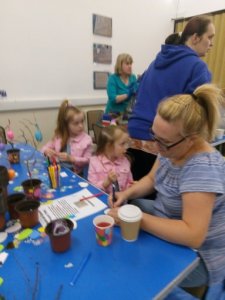

Making different Easter crafts, like Easter masks, Easter baskets, Easter crosses etc.


We also enjoyed making gratitude flowers, praying for our families through our prayer tree and taking part in a treasure hunt all about Easter!
Thanks to all who attended and to all who helped make this a very enjoyable holiday activity day!
Easter Fun Day
Yesterday we hosted the ‘Churches Together’ Easter Fun Day, which looked at the message of Easter through stories, crafts and games.
Setting up beforehand:


We had help from many volunteers from different churches and from the Family Centre:


We enjoyed a lovely lunch of scrambled eggs on toast, fish finger butties and sandwiches, cakes and fruit as we remembered Jesus cooking breakfast for his disciples after the resurrection. Our thanks to the Salvation Army volunteers for their cooking!

Mess
I’ve just had to have a wall in my house replastered because cracks appeared in it after wood was burned in the fireplace next door during building renovations there. All the old plaster had to come off before new plaster could be applied, a dusty, messy process.
We diligently covered furniture and carpets, creating a dust-free zone through tarpaulins and dust sheets, but even so, the air was thick with plaster dust when we arrived back home and it took time to sweep up all the mess, wash down doors and restore the room to order.
Mess is a part of life. It’s a part we generally don’t like and usually try to avoid, but sometimes it’s inevitable. When the pressure’s on, we don’t always get it right. The mess that results – broken trust, shattered peace, fractured families – can be hard to clean up.
Nicky Gumbel reminds us that Peter knew all about mess. Despite his bluster and bravado, when Jesus was arrested, he followed only at a distance and was quick to deny he even knew Jesus (Luke 22:54-62). His faith apparently disintegrated under pressure.
If the story ended there, it would be a familiar one to us of failure and mess. But for Peter, yesterday’s mess was transformed to today’s message. (Nicky Gumbel) The story doesn’t end with mess. Peter’s sorrow and repentance led him to a place of restoraton. The story of ‘Peter and the Big Breakfast‘ (based on John 21:1-13, which we will be looking at today at the fun day) tells us Peter was ‘ashamed, sad, confused’ as he pondered his denial, Jesus’ death on the cross and His resurrection. None of it seemed to make much sense to him But as he went fishing (unsuccessfully), he met Jesus again on the beach and all was changed. Peter found forgiveness, affirmation and was given a new job: ‘feed my lambs… feed my sheep.’

From fisherman to fisher of men… from failure to fearless follower… from messed-up Christian to a man with a message and a mission, Peter reminds us that mess doesn’t get the last word with Jesus. When we mess up, there’s still hope.
Catalysts and choices
A catalyst is a substance that causes or accelerates a chemical reaction without itself being affected or changed. One example of this is the catalytic convertor in a car which contains the catalyst platinum which changes carbon monoxide (which is toxic) into carbon dioxide (which is not.)
In life, circumstances may act as catalysts to our lives, causing change to occur. The way we react to these circumstances will, however, be determined by our choices.
In the TV series ‘Breaking Bad’, Walter White, a mild-mannered chemistry teacher approaching fifty, married with a teenage son with cerebral palsy and a new baby on the way, is already facing change as an older parent when a terminal cancer diagnosis rocks his world. Faced with increasingly expensive treatments for his cancer and frustrated by his feelings of irrelevance and dissatisfaction that his knowledge of chemistry has not led to the fame and fortune he dreamed of when younger, Walt takes to a life of crime, becoming a leading manufacturer of the drug crystal meth.

The series charts his descent from a decent, ordinary family man into a drug baron not averse to deceit and murder with absorbing and chilling skill. We see how the cancer may have been a catalyst for Walt, but the choices he makes – ostensibly from ‘good’ motives, to provide financial security for his family after his death – are the things which determine his fate.
I have long been fascinated by motivation and how the same events – a cancer diagnosis, the loss of a loved one, life-changing events such as paralysis – affect individuals and how different people’s responses are. Ultimately, life’s catalysts are not the determining factor in how we live. Our choices are. How we choose to respond to life’s catalysts is the really important factor in our lives, not what catalysts come our way. Jesus said, ‘the things that come out of a person’s mouth come from the heart, and these defile them. For out of the heart come evil thoughts – murder, sexual immoralityk theft, false testimony and slander.’ (Matt 15:18-19) He reminded us that a good tree cannot bear bad fruit and a bad tree cannot bear good fruit. (Matt 7:18) Who we really are will determine our chocies, which will lead to action. The road to hell is certainly paved with good intentions, as Walt demonstrates. Every choice we make determines to some extent how our lives will turn out. There is a deep irony in the series in that his actions actually end up alienating and damaging his family, even though he acted initially to help them.
In the final episode of ‘Breaking Bad’, Walt finally admits that the motivation for his actions was his own selfishness as much as any altruistic motive. He enjoyed the thrill of wrongdoing; it made him feel alive again. We have to be careful not to justify or rationalise sinful choices, for sin deceives us and is an inexorable taskmaster (worse than Walt or his previous boss, the equally mild-mannered but utterly ruthless Gus Fring!) Sin is a slave driver indeed. In Christ, however, we have the power to make wise choices, to live in a totally new way which absorbs all of life’s catalysts and allows these to become transformational forces. This is why Paul can confidently say, ‘we know that in all things God works for the good of those who love him, who have been called according to his purpose.’ (Rom 8:28) We are predestined to be ‘conformed to the image of his Son’ (Rom 8:29) and every one of life’s catalysts can further this process of moulding us to be like Jesus – if we allow them to.
Empty Wrappers (2)
We can be guilty sometimes of viewing faith as something entirely personal, based on feelings, but Christianity is rooted in historical fact and in a historical person. The life and death of Jesus Christ are facts which are central to our faith and Paul made it clear that the resurrection of Christ is central to our beliefs. (1 Cor 15:12-14) If there is no resurrection, then our preaching and faith are both useless.
The early disciples were radically changed by the resurrection of Jesus, but their personal testimony was based on the fact of Jesus’ resurrection. No body was produced to refute the claims of the resurrection, even though the Romans and Jewish leaders would have loved to be able to disprove the testimonies! The disciples – so fearful and anxious before the resurrection – were prepared to lay down their lives afterwards because they trusted that there was a hope beyond the grave; their future was secure because they saw that Christ had conquered death.
Our faith is based on a truth that has transformed lives over the centuries and which continues to transform our own lives. The resurrection is a fact of history that we have a responsibility to make known, a responsibility to share. Will we take this responsibility seriously and live to make Him known?

Empty Wrappers
One of Garry’s pet hates is coming to a tin of chocolates expecting to find chocolates and only finding empty wrappers in the tin… The sense of disappointment and anticlimax is intense when that happens!

In Mark 15:42-46, we read of the burial of Jesus, how Joseph of Arimathea (a prominent Jew) went to Pilate and asked for Jesus’ body and took it to his family tomb, wrapping the body in linen. Later, the women who first witnessed the resurrection of Jesus told the apostles of this great news, but the apostles did not believe the women, because their words seemed to them like nonsense. (Luke 24:9-11) Simon Peter and John went to investigate these claims of an empty tomb for themselves. There, they saw the strips of linen lying there as well as the cloth that had been wrapped around Jesus’ head. (John 20:6-7) In effect, they saw an empty wrapper!
John believed when he saw this, but Peter still didn’t understand the significance of what he had seen. In fact, there were a variety of responses to the news of the resurrection of Jesus, ranging from belief to puzzlement to unbelief (Thomas’s ‘I will not believe‘ in John 20:25) Even today, the resurrection elicits a variety of responses. Some dismiss it out of hand, saying it’s impossible. Others produce rational explanations (they went to the wrong tomb or perhaps Jesus was not really dead), but it is highly unlikely that Jesus was not dead, since he suffered flogging and crucifixion, and the sign of blood and water flowing out from the spear wound (a medical fact due to circulatory shock and heart failure).Others may talk of a stolen body (rather like Garry’s stolen chocolates!), but the consistency of the apostles’ testimony and lifestyles after the resurrection belie this theory.
If the resurrection is true, then it is a truth which has the power to change lives and we need to share this truth. The empty wrappers found in the tomb are not a disappointment, but unveil an incredible revelation that Jesus is alive and reigns on high! Let’s take this truth and share it with all we know.