

The Father of Faith
Abraham is the key example to us in the Old Testament of someone who didn’t have all the answers but who still trusted God. God had promised Abraham He would give him a son in his old age. Abraham and Sarah were old and had been married a long time and it didn’t look like they would have children. Abraham was rich, but it all seemed pointless to him if he didn’t have a son to leave his wealth to. So God promised he would have a son and Abraham believed that promise for very many years. He didn’t always get it right: sometimes he tried to sort it out himself and get a son by sleeping with his wife’s servant. But ultimately, as he carried on believing God, God gave him a son. Paul says, ‘Against all hope, Abraham in hope believed and so became the father of many nations, just as it had been said to him, “So shall your offspring be.” Without weakening in his faith, he faced the fact that his body was as good as dead—since he was about a hundred years old—and that Sarah’s womb was also dead. Yet he did not waver through unbelief regarding the promise of God, but was strengthened in his faith and gave glory to God, being fully persuaded that God had power to do what he had promised.’ (Rom 4:18-21)
Abraham didn’t expect the answer to come from his own body anymore. He didn’t expect the answer to come from his own reasoning. He knew he needed a miracle from God and that’s what he got. He didn’t stop believing God, even when he didn’t understand. That’s why he’s called the father of faith, because he kept on believing.
Even when we don’t see… even when we don’t understand… even when we’re bewildered and confused, we can still believe. God wants us to live by faith and not by sight, to be like Abraham who was declared righteous by God because of his faith. Paul says that doesn’t just apply to Abraham. He said, ‘the same thing gets said about us when we embrace the One who brought Jesus to life when the conditions were equally hopeless.’ (Rom 4: 24, The Message) A dead man doesn’t come back to life, does he? But Jesus did, and because of His death and resurrection, we can be set right with God and can have a hope that lasts beyond this lifetime. Even when we don’t have the answers, we can still believe and trust that God knows what He’s doing and will sort everything out. Even when we don’t see, we can still believe.

Believing When Bewildered (2)
Often, when we are confused and bewildered and don’t seem to have any answers to big questions (‘if God is so loving and powerful, why has this happened?’), the temptation is to give up. We conclude that God must either be not so loving or not so powerful and we stop believing what God says about Himself and come to our own conclusions. Jesus talked about this a little when He told His disciples the parable of the sower. In that parable, he talked about sowing seed into different kinds of soil and how much growth there was. Then He said, ‘When anyone hears the message about the kingdom and does not understand it, the evil one comes and snatches away what was sown in their heart. This is the seed sown along the path. he seed falling on rocky ground refers to someone who hears the word and at once receives it with joy. But since they have no root, they last only a short time. When trouble or persecution comes because of the word, they quickly fall away. The seed falling among the thorns refers to someone who hears the word, but the worries of this life and the deceitfulness of wealth choke the word, making it unfruitful. But the seed falling on good soil refers to someone who hears the word and understands it. This is the one who produces a crop, yielding a hundred, sixty or thirty times what was sown.’ Matt 13:19-23)
Jesus said if we don’t understand something, the evil one comes and snatches away what was sown. We don’t let the seed stay there to grow in due time; instead, we just give up on God. Or when trouble or persecution comes, if we don’t have roots in God, we’re uprooted and give up. Sometimes the worries of this life and the deceitfulness of wealth choke out what God wants to do in our lives. We worry instead of trusting, or we trust in the wrong things, thinking that money will make us happy. All these reactions stop us from believing God and pressing on with Him.
The disciples had doubts and questions about whether it really was Jesus, alive from the dead, but that didn’t alter the reality of the resurrection! What we need to do with our doubts and questions is bring them to God. Instead of running away from Him because we don’t understand and we’re scared, we need to walk by faith and not by sight.

Believing When Bewildered
Most people like quizzes; these are one of the most popular TV shows, with quizzes like Mastermind or Who Wants To Be A Millionaire? drawing large audiences. We like to be able to answer questions and show off our knowledge.

Unfortunately for us, life is not quite as easy as knowing the answers to the questions on a quiz show. Whilst we do know the answers to many questions – the Bible tells us how God made a perfect world, but Adam and Eve’s rebellion against Him led to sin entering the world and with sin, death; it also tells us of God’s plan of salvation, sending His Son to die for our sins so we can be restored to a relationship with Him – there are many more we don’t have answers to. This can easily lead to us becoming bewildered, rather like the disciples when confronted by the resurrection of Jesus. They found it hard to believe the women’s tale (Luke 24:11); the disciples on the road to Emmaus were utterly confused. (Luke 24:22-23) Even when they met the resurrected Jesus, some still doubted. (Matt 28:17)
Whilst we would much prefer to have the answers to all of life’s questions, God calls us to live by faith and not by sight. (2 Cor 5:7) We are called to a relationship with God where He wants us to learn to trust Him and not to worry about having all the answers. It’s good to know as much as we can about God, about the world, about lots of different topics, but knowledge isn’t the be-all and end-all of living well. Instead, what matters is that we trust God every single day, that we understand life is about our relationship with God and with each other and that it’s OK not to have all the answers. God wants us to trust Him even when we don’t have answers and even when we can’t see what He is doing. He is big enough to take all our questions and He wants us to bring all our doubts, questions, fears and worries to Him, rather than reaching conclusions based on our limited knowledge. God is still good; ‘what’s true in the light is still true in the dark.’ (‘Weep With Me’, Rend Collective) We can still believe, even when we cannot see.
Being Creative
This week has been busy at GPCC as we hosted four creative workshops run by Kingdom Consortium members as part of the national Age of Creativity’ festival. This aims to get people over 50 involved in the creative arts, not only because these are fun but because there are significant health benefits (phyiscally and emotionally) to being involved in ‘creative and cultural participation.‘ We didn’t have any age limits on our workshops, so we had teenagers and older people, along with everyone in the middle, involved this week!
One session gave us the opportunity to try our hands at needle felting, as we made little mice. Needle felting basically involves stabbing pieces of unwoven wool until a shape is formed and many commented on how therapeutic they found this apparently vicious activity!


Next up was drawing, where people enjoyed learning to draw leaves and get the shading right!


Then we had a session on poetry and song, looking at how poetry can express emotions on a range of levels and how the psalms are great poems leading us into honest communication with God.

Finally, we had a singing workshop where we were encouraged to learn how to breathe properly (using the diaphragm) in order to sing without strain and to sing with dynamics!
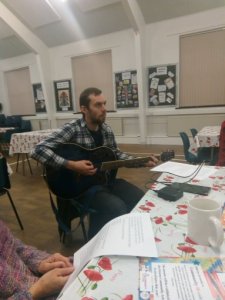


Creativity comes in all kinds of different forms and we will enjoy some more than others. It was good to have the opportunity to tackle new things, however, and to see the benefits that the arts bring to us. The motto of Kingdom Consortium is ‘arts change hearts’ and this is true on so many levels.
Tunnels and Mountains
My granddaughter has an excellent book about trains called ‘Terrific Trains’ which seeks to teach young children about trains using rhymes to do so. When I first read the book to her, one page in particular captured her attention: “When a train meets a mountain, it doesn’t have to stop. It travels through a tunnel and your ears go ‘pop!'”
I don’t know which part of this page – the alliteration, the rhyme, the word ‘pop!‘ or the engaging pictures – so captured her attention, but for weeks, this was the only page she wanted me to read, and so it became a parable to me.
A mountain is an impregnable obstacle to a train journey. A mountain stands majestic, but cannot be ignored. Life is full of metaphorical mountains, full of obstacles which are far greater than our ability to circumnavigate!
For the train journey not to simply end when the train meets the mountain, engineers and builders have to make tunnels. It’s a long, laborious process, requiring skilled knowledge and machinery, but the result is indeed that when a train meets a mountain, it doesn’t have to stop. The journey can continue.

Jesus spoke about faith as small as a mustard seeing having the power to move mountains (Matt 17:20). Sometimes we face situations that are impossible for us to overcome. What we need in those life situations is faith in God, the God of the impossible who has delivered us and will continue to do so. (2 Cor 1:10)
Sometimes the obstacle will be removed. The fault-finding, critical, hostile boss will move on to another job, freeing us to work in harmony again. The bullying, aggressive pupil will be gone, leaving us to enjoy learning again. Butat other times, God makes a tunnel. He enables us to bear a situation which was unbearable. He enables us to carry on when we feel like giving up. He rescues us in less obvious, unexpected ways.
Whether the mountain is removed or we learn to scale it (one weary step after another) or go through it (thanks to a ‘tunnel’ God provides) is irrelevant. When we meet the mountain, we don’t have to stop. We can continue to press on in God. We keep going, thanks to His unfailing love and ever-present help. Our ears may not go ‘pop!’, but our hearts swell with gratitude and wonder as we recognise the Lord helps us to continue our journey in faith and hope.
I am praying for ropes, tunnels and other miracles today to change situations and make the impossible possible with our God.
Diffident Faith
Gideon is one of my heroes because his diffident faith reminds me so much of myself. For many Christians, he’s nobody special, a bit of a wimp. Judges 6, which tells of his calling to rescue Israel from the hands of the Midianites, seems to many to be an object lesson in obfuscation and doubt. They are scornful of his questions and constant ‘bargaining’ with God, with his fear (he built an altar to the Lord at night because he was afraid of his family and the townspeople, we read in Judges 6:27) and with his sheer uncertainty. It is these characteristics, however, which offer me hope, because I see this shyness and uncertainty as arising from his lack of self-confidence. Gideon reminds me that God doesn’t only use confident, assertive people. He uses wimps, cowards, doubters and fearful people as well! – and therefore there’s hope for me too!
Gideon asks many of the hard questions we’d prefer to ignore (‘if the Lord is with us, why has all this happened to us? Where are all the wonders that our ancestors told us about…?’ Judges 6:13) His conclusions may be flawed (as ours often are, believing the Lord has abandoned us in times of testing, even though the very conversation he was having with the angel of the Lord was actually proof that this was not the case), but his raw honesty is something I believe we should emulate, not hiding our confusion beneath pious platitudes but being real with God.
It’s perhaps in his need for reassurance and affirmation that I most identify with Gideon. He seeks reassurance and confirmation from God by making an offering to Him and putting fleeces out so God can demonstrate His awesome power (Judges 6:17-23, 36-40). Some may feel this is putting God to the test, but I believe Gideon’s reported politeness (‘pardon me, sir‘) and humility (‘do not be angry with me‘) indicate a fearful heart, not an unbelieving one. God’s graciousness to Gideon (offering him hope and the revelation ‘the Lord is peace’ (Judges 6:24)) goes a long way to mitigating my fears and offering me reassurance.
We like our heroes to be tough, dynamic and fearless, but Gideon – named in Hebrews 11, that chapter listing heroes of the faith – reminds us what makes a hero is not a person’s flawed personality but the presence of God with them, a lesson from which we can all take comfort and reassurance.
