

Obstacles or opportunities?
Yan’s words about attitudes reminded me of our visit to Ramsey Elim Community Church last week while we were on holiday. Part of the service involved a prayer walk around the town, stopping at different locations to pray for various needs. Unfamiliar with the area, we were pleased to be in a group which visited a local park and children’s play area!
As we talked and prayed, I felt drawn to two parts of the park. One looked like a well with a vane on top of it. The well was actually a shelter for young people, but its form reminded me of all we have been learning about the water of life and the vane reminded me of God’s promises to bring people to us from the east, west, north and south. (Is 43:5-6)

The other item of play equipment which seemed to me to be profoundly prophetic was an obstacle course:

Children loved this obstacle course and approached it with enthusiasm and vigour. As an adult, I looked at it with very different eyes, seeing challenges and obstacles which looked daunting and induced fear. There, in a nutshell, was the challenge before each one of us. Do we view life as an obstacle course, with insurmountable hurdles and challenges which will always defeat us? Or do we view life as a series of opportunities placed before us by a God who knows us and loves us?
In reminding us of the need to change our attitudes towards God, ourselves and our circumstances, Yan essentially challenged us to understand that the obstacles we face – like Paul’s ‘thorn in the flesh’ – are actually opportunities for growth. Our attitude really does determine our altitude. I want to soar on eagles’ wings with God. I want to thrive on the opportunities God gives, even if they come clothed in the garb of obstacles. I want to be like those children who were as eager to complete this obstacle course as they were to climb up slides or enjoy the swings in the park. We can do this because God’s grace is indeed sufficient for us.
Weakness Is Our Greatest Strength (2)
Yan’s third point in his sermon ‘Weakness Is Our Greatest Strength’ asked the question ‘How do we turn our weakness into strength?‘ We do this as we live by spiritual principles rather than rational understanding. In order to see weakness turned to strength, we must:
1. realise the need of spiritual awakening in our lives, churches and country. Isaiah 52:1 urges Zion to ‘awake!’ and to ‘clothe yourself with strength’. Apathy and indifference must be banished; distraction must be put aside.
2. recognise the need to change our attitudes. Our attitudes determine our altitude. We are actually seated with Christ in heavenly places (Eph 2:6), but so often we live with our eyes to the ground, shuffling along (see Col 3:1-2, The Message). We need to reject unbelief and low expectations and develop ‘great expectations‘ instead! We have to examine our attitudes to God (Eph 3:20 reminds us that God can do immeasurably more than all we ask or imagine), to ourselves (Joel 3:10 reminds us that the weak can say ‘I am strong’; we need to understand what God says about us instead of wallowing in self-pity or low self-esteem) and to our circumstances (rejecting grumbling and complaining in favour of thankfulness, as 1 Thess 5:18 urges.)
3. re-establish the importance of God having first place in our lives. Jesus taught us to seek the kingdom of God above everything else (Matt 6:33) and we need to consider what is our ‘one thing’ or prime motivator (see Ps 27:4). Ps 84:5-7 reminds us that even when we are in the valley of Baka, pools and springs can arise.
God gives power to the weak and enables strength to come as we wait on Him. (Is 40:29-31). Instead of being defeated and discouraged, we can be encouraged as we take to heart God’s call to awake and clothe ourselves with God’s strength, not ours.

Weakness Is Our Greatest Strength
Yan Hadley’s provocative title ‘Weakness is our greatest strength’ cuts across our preconceived ideas of success. God’s word frequently speaks of paradoxes, however: how we must lose our lives in order to gain them, how the first will be last and so on. In 2 Cor 12:7-10, Paul identifies another of these paradoxes, how weakness can be our greatest strength. We can only really understand this as we appreciate God’s thoughts and ways are so vastly different to ours (Is 55:8), something best revealed in the person of Jesus Christ, who was born in a lowly stable in a small town in a relatively insignificant country and who ultimately achieved our salvation through the unlikely means of dying on a cross.
So often, we view ourselves as insignificant or unworthy, but God calls those who may well seem to have little going for them (1 Cor 1:26) in order that He may get the glory! We should not despise the little things; Terry Waite (envoy of the Archbishop of Canterbury who was kidnapped and imprisoned for five years in the Middle East) spoke of how a postcard sent from a lady in Bedford encouraged his faith while he was in captivity. God’s power is made perfect in weakness. (2 Cor 12:9)
What Do We Mean By Weakness?
Here, we are not talking of sin or lack of self-control or weaknesses which are harmful, but rather of an awareness of human frailty which leaves us dependent on God. Instead of seeing our weaknesses as obstacles or barriers, we see that God is able to turn these into opportunities (as Jesus did with the meagre lunch offering of that boy!) Many examples of human frailty abound (e.g. Kathryn Kuhlman, used greatly by God in miraculous healings, declared God could use her because she had nothing; Gladys Aylward was rejected by every missionary society yet still went to China and saw God move in power there; Smith Wigglesworth was an uneducated plumber used powerfully by God, as was William Seymour, a key figure in the Azusa Street revival which saw the beginnings of the Pentecostal movement in the 20th century.) The truth is that when we are weak, we can be strong in God’s strength.
Why Is Weakness Our Greatest Strength?
Weakness is our greatest strength if it allows us to cultivate our dependence on God. Apart from Him, we can do nothing (Jn 15:5). Paul was overwhelmed by weakness at times, but this developed his trust in God (see 2 Cor 1:8-9). As a result of weakness, our prayer lives are developed and we learn to live by God’s wrod (Matt 4:4). Weakness develops our faith muscles as we become desperate enough to seek God (like Bartimeaus, Hannah and the woman who suffered from constant bleeding for years.) Ultimately, weakness is our greatrest strength because then God gets all the glory (1 Cor 1:29)
Weakness is our greatest strength also because it keps us from exalting ourselves; it is God’s practical aid to humility! (2 Cor 12:7) God used Moses with just a stick and a stammer; David defeated Goliath with a sling and some pebbles. Gideon’s army was whittled down from 32,000 to 300… all so that God could ensure that victory was attributed to no one else but Himself!

Conversations with Dad
Stephen asked us a poignant question this morning at Cherry Tree Court: ‘when was the last time you spoke to your father?’ For some people, bereaved many years ago, it may be difficult to recall that last conversation; for others who have never really known a father, it’s a bittersweet question to face. But whatever our experiences of conversations with fathers (mine was, at that point, yesterday, to let him know we had returned safely from our holiday!), we are able to think about our last conversation with our heavenly Father.
Today is Fathers’ Day, but the wonderful truth is that as a Christian, every day can be ‘Father’s Day.’ Our conversations with our heavenly Father are fuel for our lives, and in Matt 6:9-15, Jesus gives us a framework, a template, for prayer. That prayer, often know as the Lord’s Prayer or the ‘Our Father’, reminds us that we can talk to our heavenly Father about absolutely everything. No subject is off limits. We can also talk at any time: we don’t have to wait for special occasions. We can talk anywhere: just as with telephones, computers and mobile phones, we are no longer limited to a specific place to have a conversation with people, so too we are not restricted in where (or how) we can have those heavenly conversations we call prayer.
Our conversations with God can be personal, intimate and involve us listening to God as well as talking. Let’s take the opportunity to have conversations with our heavenly Father on this special day as well as with our earthly Dads if we are able.

Wallabies Gone Wild!
One of the things I love about holidays is the opportunity to find out what’s happening in other local communities regarding the arts. Knowing that Dearne Community Arts’ Festival is taking part in Thurnscoe Big Local’s ‘Go Wild’ sculpture trail in the summer holidays, I was stunned to find a similar arts’ project on the Isle of Man. The hospice there has been involved in a sculpture trail called ‘Wallabies Gone Wild’ involving 64 painted sculptures of wallabies and I had great fun tracking these down! (for more information,see the website here).
Here are some of the amazing wallabies I found on holiday:
At Castletown:
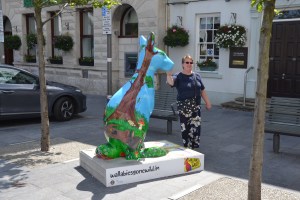
At Maughold:

At Peel:

At Port Erin:

At Port St Mary:

At Ramsey Mooragh Park:

At Ramsey:

The Thurnscoe ‘Go Wild’ sculpture trail will take part in the school holidays, but Dearne Community Arts’ Festival will be decorating the sun bear on Saturday 27th July at the ‘Love Your Park’ event (12-4 .p.m.) at Thurnscoe Flower Park. We’ll be decorating our sun bear with snippets from famous paintings using the art form of decoupage and he’ll then be in the sculpture trail and on display at the Dearne Community Arts’ Festival on Saturday 28th September at Astrea Academy Dearne. If you’d like to have a go at something a bit different and be part of championing creativity and celebrating community, then come along to be part of our very own sculpture trail!

A Fathers’ Day Meditation
Today is Fathers’ Day, a ‘designated day’ in the UK calendar to celebrate fathers. Many feel such days are artificial and overly commercial and that it is not wise to be attached to them, but the Bible reminds us to honour our father and mother and this can be an opportunity to thank fathers for their often unsung influence and input into our lives.
Fathers have a vital role to play in a child’s upbringing and development, but we live in a society where fathers are often marginalised, playing a peripheral role, if one at all. Many children do not know their fathers, have little or no contact with them and have few male role models in their lives. Other children, even if they live with their fathers, see them as remote and distant. To be a good father is a difficult job.
Jesus talked frequently of his relationship with God as a father-son relationship. We know very little about his relationship with Joseph, the man who assumed paternal responsibility for him (it’s believed Joseph died when Jesus was relatively young), but a lot about the intimate relationship he had with God. He talked about God as his Father (John 5:17-18) and said, ‘the Son can do nothing by himself; he can do only what he sees his Father doing, because whatever the Father does the Son also does.’ (John 5:19) Fathers influence us more than perhaps either they or we realise. What a father does, a child will automatically copy.
This is both a sobering and challenging thought to ponder on this Fathers’ Day. Fathers, what are you doing which your child will also do? Are you modelling a life of faith? Are you showing your child how to walk in the Spirit? Are you demonstrating godly values? Or will your child see impatience, objections, a dog-eat-dog mentality, a workaholic who is forever saying ‘not now’ or ‘later’? Our lives can seem so busy, so frantic, so constrained. Do our children know they are unconditionally loved, accepted and welcome or are they learning they’re an inconvenience in our world?
Jesus sad, ‘the Father loves the Son and shows him all he does. Yes, and he will show him even greater works than these.’ (John 5:20) A good father loves his child and spends time with him. A child primarily learns skills and confidence from parents. Jesus talked of the Father giving responsibility to him. (John 5:22-23) We too need to give responsibility to our children as they grow, for how else will they become trustworthy, competent adults?
Today, fathers, reflect on the awesome privilege you have as fathers to shape, influence and model God to your children. This is your primary role as a father. Children, today reflect on the fact that no matter what your earthly experience of fatherhood has been, you have the opportunity to know God as your Father in the same intimate and loving way that Jesus did. Let’s rest in that relationship and, like Jesus, seek to do only that which pleases the Father. (John 8:29)
