

Life In The Early Church
Acts 4:32-37, like Acts 2:42-47 before this, gives us a cameo of life in the early church. It’s a very positive picture, with all the believers united (‘one in heart and mind’ Acts 4:32) Their unity is expressed in terms of their commitment to share practically with each other to ensure that there was no one in need. John Stott comments that their ‘economic sharing was but one expression of the union of their hearts and minds.’ (John Stott, P 106) He goes on to comment that ‘their radical attitude led to sacrificial action’, something John later urged all believers to imitate (1 John 3:16-18).
It can be difficult to know how to apply these principles nowadays. We cannot compel this kind of action (it was not compulsory even in the early church, as Acts 5 makes clear), but neither should we dismiss it as unreasonable and impractical. We are still called to take care of the needy and to demonstrate sacrificial generosity (see Deut 16:4-5, 2 Cor 9:6-8). Both James and John make it clear that faith without works, faith which is not seen in action, is useless (see James 2:1-26). What comes through very clearly in these early chapters of Acts is a group of people united, committed to each other and seeking to serve God in practical ways. We need to be the same.
The example of Barnabas, practically demonstrating love and commitmen by selling a field and giving the proceeds from this to the apostles to use to bless others, is then contrasted with the example of Ananias and Saphhira in Acts 5. But that’s another story… to be told in our next Bible study!

A Prayer For Healings, Signs and Wonders
The believers gathered together to pray in Acts 4:23-31 did not simply pray for boldness. They also asked God to do miraculous things: ‘Stretch out your hand to heal and perform signs and wonders through the name of your holy servant Jesus.’ (Acts 4:30)

We need to learn to pray in this way, asking God to heal and perform signs and wonders through Jesus’ name. We need to do this because it is clearly a Biblical way of praying and because when God moves in these supernatural ways, God’s word is confirmed and people are drawn to faith.
Our prayers need to have this same dual focus. We need God to work in us, giving us the courage and boldness to do what He asks us to do, but we also need to plead with God to work in ways that are far beyond us. Christianity is a religion of miracles. It’s the story of how God Himself came into our world and took the initiative; it’s His story, not ours. People need to see the acts of God for themselves; they need to know that God is alive and working in our community at this particular time.
Our prayers should not simply be for ourselves, but for our communities, our nation and our world, that God will stretch out His hand to heal and perform signs and wonders through the name of Jesus. Isaiah prayed, ‘Oh, that you would rend the heavens and come down, that the mountains would tremble before you!’ (Is 64:1) Nothing less than the supernatural power of God is needed to turn people away from sin and towards God.
A Prayer For Boldness
The believers gathered together to pray in Acts 4:23-31 did not pray for deliverance from persecution in itself. Their chief concern was that God would enable them to speak His word with ‘great boldness’ (Acts 4:29).

This is a great prayer for us all to pray. Most of us feel very timid about speaking to other people about Jesus. We are afraid of being ridiculed or getting into trouble; we feel incompetent and worried that once we start to talk about Jesus, we will be asked questions we can’t answer or will find ourselves out of our depth and unable to swim! In this day and age of political correctness and crimes of hate speech, we are worried how our words about God may be interpreted by others and can be almost paralysed to speak of our Lord and Saviour in case we are misunderstood or misinterpreted.
At the same time, we know that God calls us to be His witnesses (Acts 1:8) and that we need to be telling the stories of God to all we meet (Ps 78:4-7, Ps 107:2) It’s therefore a great prayer to pray: ‘enable me, Lord, to speak Your word with great boldness.’ If Paul could ask the Ephesians to pray for him ‘that whenever I speak, words may be given me so that I will fearlessly make known the mystery of the gospel’ (Eph 6:19), we can pray for this same boldness and fearlessness to know how to make known the mystery of the gospel to those we meet on a daily basis. The Bible reminds us that the righteous are as bold as a lion (Prov 28:1). May God give us this lion-like boldness, far beyond ourselves, to speak His word wherever we are.
The Ripple Effect
Whenever we’re near a river or a beach, Garry likes to throw pebbles into the water, skimming them with skill so that the water ripples out as the pebble hits it. My efforts to emulate him never end in ripples; my pebbles tend to hit the water with a thud or plop and sink to the bottom without trace; not for me the pleasure of seeing the pebble skim lightly on or the water rippling out!

The ripple effect is defined as ‘the continuing and spreading results of an event or action.’ The healing of the cripple described in Acts 3 was like a pebble being thrown into water; it created ripples all around. Some of these were positive (2000 people being added to the church); some less favourable (an overnight stay in prison for Peter and John and a subsequent interrogation by the religious rulers resulting in being instructed not to speak in the name of Jesus again!) In all of this, however, we see how God can use one relatively small thing to have an impact that is far greater than we could ever have anticipated.
The gifts of God’s Spirit, including healings, are often used by God to do far more than we would expect. Healings are amazing and marvellous, but the work of God’s Spirit in an individual’s life is often the catalyst to bringing other people to faith and aiding the spread of the gospel message. It has an effect far beyond the personal, incredible and liberating though this is for the individual concerned. This applies to all those supernatural gifts Garry was talking about last week and is another reason we need to pray for these gifts to be seen in our time and in our church, because it’s not simply about one person being blessed and helped. As we see God move in power – whether that’s through a word of knowledge or wisdom or through a manifestation of God’s miraculous power or healing, through other languages or prophecy – our own faith increases and we are enabled to talk about what God has done to others who can visibly see God in action.
The ‘ripple effect’ doesn’t just apply to the miraculous, however. God always takes our small offerings and turns them into something bigger. The little boy’s lunch fed more than 5000 people. The widow’s jug of oil lasted far beyond one batch of loaves. When we do something in God’s name, however small and insignificant the act may look to others, it has the capacity to create a ‘ripple effect’, touching other people and drawing them closer to God. These things are often described as ‘acts of random kindness’, and certainly we should be seeking to demonstrate the fruit of the Spirit (including kindness, gentleness and goodness) to others as well as seeking God for the gifts of the Spirit. Everything we do has the power to touch others: let’s ensure we’re blessing and building others up in all we do and say.

Sovereign Lord
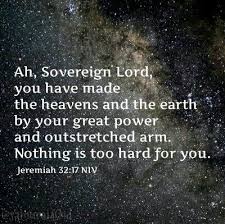
The phrase ‘Sovereign Lord’ (from which we get our word ‘despot’, a ruler with absolute power) is not used very much in the New Testament, but it’s a reminder that God is in supreme control and cannot be thwarted by man’s scheming and plotting. Jeremiah says, ‘Ah, Sovereign Lord, you have made the heavens and the earth by your great power and outstretched arm. Nothing is too hard for you’ (Jer 32:17) and the apostles, soaked in the Old Testament, pray to God in the assurance that He is firmly in control. No matter how much Herod and Pilate have schemed against Jesus, ‘they did what your power and will had decided beforehand should happen.’ (Acts 4:28) The machinations and plots of rulers and kings against the Lord’s Anointed One (see Ps 2) have a very special relevance to the believers as people try to restrain their confident witness, but these believers have absolute trust in God as Lord over all.
Hezekiah, when faced with a great threat from an opposing army led by Sennacherib, king of Assyria, prayed with similar confidence in God’s sovereignty: ‘Lord, the God of Israel, enthroned between the cherubim, you alone are God over all the kingdoms of the earth. You have made heaven and earth. Give ear, Lord, and hear; open your eyes, Lord, and see; listen to the words Sennacherib has sent to ridicule the living God.’ (2 Kings 19:15-16) Bolstered by Isaiah’s prophecy, he saw thousands slaughtered without having to lift a hand: ‘That night the angel of the Lord went out and put to death a hundred and eighty-five thousand in the Assyrian camp. When the people got up the next morning—there were all the dead bodies! So Sennacherib king of Assyria broke camp and withdrew. He returned to Nineveh and stayed there. One day, while he was worshipping in the temple of his god Nisrok, his sons Adrammelek and Sharezer killed him with the sword, and they escaped to the land of Ararat. And Esarhaddon his son succeeded him as king.’ (2 Kings 19:35-37) God has ways of resolving situations that threaten us which we cannot even begin to comprehend.
Jesus reminded His disciples, ‘with God all things are possible.’ (Matt 19:26) The Sovereign Lord is our God!
He’s Got It In Hand!
Acts 4:23-31 gives us an indication of what happened next after the authorities threatened the apostles following the healing of the crippled man at the temple gates. Far from being cowed or terrified by the threats, the apostles gathered together with other believers and prayed, not for deliverance or escape from persecution but for the ability to continue witnessing boldly.
This confident response (so at variance with their fear and trembling following the crucifixion of Jesus) reflected their growing conviction that God was in control. In their prayers, they addressed Him as ‘Sovereign Lord’, acknowledging His role as creator and sustainer of the universe. Human opposition was seen as futile and fruitless; their reference again to Old Testament Scripture (Ps 2) showed that no matter what plotting and scheming exists against God’s Anointed One, it will not prevail.
If we are to live confident, courageous lives, witnessing for God in the face of opposition and persecution, we need to examine our view of God. Matt Redman says, “A big view of God is a cure for so many of the things in life that would stand in our way or slow us down in ministry. When we really grasp the heights of who He is, and the depths of His heart for us, and the strength of His power in us, we can live a whole different kind of life. The way we view God will radically affect how our lives operate… We must see and believe Him as big enough, kind enough, real enough and strong enough to move in power in our everyday lives – no matter what we’re facing. The first step for a worshipper is to confidently get to grips with just how magnificent and mighty He is. The next step is to let that confidence in God seep into the very depths of our hearts and minds, forming a holy confidence on the inside of us. When that truly happens, we will dream bigger dreams and live brighter lives.”
It’s crucially important that prayer starts with our eyes on God and not on the problem. The believers focussed on God’s authority, power and strength before they moved on to their situation and their petitions. So often, we plunge right into prayer, listing our woes and laments, but if we consider the framework of the Lord’s Prayer (Jesus’ ‘model prayer’ for us), this too begins with an awareness of who God is and an adoring response to this awareness: ‘our Father in heaven, hallowed be Your name.’ (Matt 6:9) Perhaps one reason we question whether God hears and answers our prayers (quite unlike these disciples whose prayers led to the room being shaken and them all being filled with the Holy Spirit and continuing to speak the word of God boldly!) is because we’re not praying from this same conviction that God is in control. When we truly see how big, magnificent and mighty God is, we will pray confidently and expectantly, certain of God’s goodness and ability to turn even disasters into dreams and tragedies into triumphs.
