

King of Me
Tonight’s ‘Little Big Church’ looked at the idea of kings and queens. Some of the children dressed up and became queens for the evening:

They were involved in knighting loyal subjects (Sir Stephen of Keys and Sir Gary of Percussion), who then had to make them crowns and sort out their thrones.


They then listened to requests from their subjects (the rest of the congregation), dispensing money to help children in Haiti and India.

However, some of the requests could not be solved by gold coins: a giant threatening the nation’s safety and a law banning prayer needed God’s intervention, not theirs.
The truth is that God wants us to do all we can to help people, and if it’s in our power to help, we should. There are many situations in life, however, which are beyond even the most powerful person’s ability to intervene. We need to realise that God is ‘the King eternal, immortal, invisible, the only God’ (1 Tim 1:17) and that He wants to be our King too.
Rend Co Kids’ song ‘King Of Me’ looks at the stories of David and Goliath, Daniel in the lions’ den and Jonah to remind us that these stories are not just history. They are testimony of God’s intervention in human situations, and, as the song says, ‘He will do the same for me.’ We can be confident that God is the King and is able to do far more than even the most powerful of human kings or queens.
A Willingness To Touch
Dave spoke this morning from Mark 1:40-45, an encounter between a leper and Jesus. Leprosy was one of the most devastating diseases recorded in the Bible, killing through destroying the nervous system so that limbs were lost, blindness occurred and destruction came, in effect, slowly and painlessly. It was a most disfiguring disease and lepers were treated as outcasts and shunned. They were considered ritually unclean and were not allowed to come near people or take part in collective worship. This lack of social contact and physical contact must have made life exceedingly difficult for a leper.
For this leper to approach Jesus during His public ministry took courage. He made his way through the crowds and said to Jesus, ‘If you are willing, you can make me clean.’ (Mark 1:40) He wanted to be able to take part in society again and knew that Jesus was his only hope.
Jesus healed people in many different ways, often simply by speaking a word of healing. Here, in touching the leper, He broke all the taboos of society and signified that He understood the importance of touch to the leper. Babies need human contact if they are to flourish; the tales of deprivation in Romanian orphanages in the 1990s showed us the terrible consequences of not giving babies the hugs and cuddles they need. Touch can be an important way of giving comfort, reassurance and affection (think of the way a mother hugs her child after it has fallen down in the mud or the way lovers constantly touch each other to convey their love), and in reaching out to the leper in this way, Jesus conveyed total acceptance and love. He tailors His response to our needs; He knows exactly what to do to minister to the whole person.

The Bible has other accounts of Jesus healing lepers (e.g. Luke 17:11-19), but in that narrative, the lepers remain far off, standing at a distance and shouting out to Jesus. Here, we see the benefits of drawing near to God and we have a vivid reminder that no one is too bad to come to Jesus. God can cleanse us and make us whole; He is most definitely willing to hear us when we call and responds when we draw near.
Not Getting What You Want
When we read some of the promises in the Bible about prayer, we may feel we have carte blanche to a life of unending bliss (see 1 John 5:14-15, Matt 7:7, John 14:14). Yet we soon come to realise that prayer is not a slot machine programmed to pour out coins every time we pray. We can spend a lot of time disappointed with prayer and with God because we have unrealistic expectations and because we don’t always get the answers we want.

‘No’ and ‘wait’ are as much a part of prayer as ‘yes’; waiting on God is a vital part of prayer, and in those positive verses about prayer, we see the importance of asking in Jesus’s name and according to His will. Prayer is not the spiritual path to selfishness, but an invitation to participate in a relationship with God. I listen to my granddaughter’s confidence when she speaks to me (‘I watch videos now; I get an ice-cream‘), and if her views are challenged (‘it depends. Maybe. Later’ or even ‘No‘), she nods her head and says ‘yes, yes, I say so.‘ We can be like that too, telling God, ‘yes, yes, I say so’ if He doesn’t give us what we want immediately!
So often, we believe we know better than God, but what we want is not always the best for us (a life of watching videos and eating ice-cream seems wonderful to a two-year-old, but a wise parent knows these things are not always good for us!) In the same way, God knows what is best for us and this kindness and goodness are what lie behind the ‘no‘ and ‘wait’ which so often infuriate us. Waiting and refusals do not mean God doesn’t love us, any more than my refusal to hand out an endless stream of ice-creams means I don’t love my granddaughter. We grow up when we learn to yield to HIs wisdom.
Not getting what we want in prayer can leave us feeling frustrated and disillusioned with God, but in truth, all God’s answers to our prayers are meant to shape us into His image. Rick Warren says, ‘The things you wish most removed from your life are often the very things that God is using to shape you and make you into the believer that he wants you to be. He wants to use that problem for good in your life.’ We grow up when we learn to pray as Jesus did: ‘not my will, but Yours be done.’ (Luke 22:42)
Light the Blue Touchpaper…
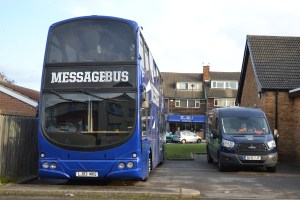
The Message Bus’s visit to our area was a day of great fun, giving children and young people the opportunity to have a good time on a bus that’s kitted out with slides, climbing wall and tons of computer games.


There’s a serious message behind the bus, however, which the local churches also want to communicate.
As people, we don’t really want to live life God’s way; there’s a rebellious streak in all of us which leads us to defy God and live independently of HIm. The Bible calls this sin and tells us it’s this which separates us from a God who is utterly pure and holy. Jesus came to earth to rescue us from sin by paying the price for sin and removing all obstacles to a relationship with God. Jesus’s death on the cross means there no more barriers to knowing God and being His friend.
Jack from the Message Bus illustrated this for the young people by taking a piece of paper and setting fire to it! The flame soon eats up the paper till there’s nothing left. In the same way, Jesus takes our sin completely away from us, so that we are now free to live life as God always intended – life in all its fulness with God at the centre.
We’ll soon be celebrating Bonfire Night in the UK, where people light the blue touchpaper on fireworks to see a dazzling display of light. The message of the Message Bus is that the Light of the World has come to take away our sin and give us the opportunity now to shine for Him! That’s why we painted lighthouses and glass jars to house candles to remind us that the light shines in the darkness and the darkness has not overcome it! (John 1:5)

The Message Bus Roadshow
It was great to welcome The Message Bus to our area yesterday. First of all, we visited Houghton Road Centre in Thurnscoe.


Inside, younger children could play with toys or do jigsaws and craft activities:


Our Big Local Thurnscoe and St Helen’s volunteers cooked us bacon sandwiches to keep us going!


We then moved on to Goldthorpe, where the bus parked in the Market Street car park and activities were on offer at GPCC.


Salvation Army volunteers made us hot dogs for lunch; here are our capable helpers (including Sue who helped with the lighthouse painting) enjoying their own lunch at the end.

Then it was on to Bolton-on-Dearne where we had more fun!

Even the lads joined in the nail painting fun!


Our thanks to all the churches who supported the fun day, to all the helpers who worked so hard to feed us and give us fun things to do and to all the community who came along!
Use Your Sword
Casting Crowns (a Christian music group) have a God-given ability to bring piercing prophetic picture messages through song. Their songs tackle specific issues we face in life and remind us of the weapons we have through prayer, praise and the Word of God to defeat every enemy that comes against us.
One of these haunting songs is ‘Waiting For The Night To Fall’, a song which warns us we have an enemy (described as ‘an old man living in the back of your woods’) and that he seeks to rob us blind of the many blessings God has for us. The imagery of darkness and night in contrast to the daytime and light is one used repeatedly in Scripture to show us the contrast between the devil and God (see John 1:4-5, John 8:12, John 12:35).
In the song, we have the piercing lyric:
“He knows you have the answers, but Truth lies dusty on your shelf/ And the sword that you could slay him with has become an ornament and nothing else.”
God’s word is given to us to be a sword that cuts through lies and slays the enemy and the ‘old man’ (our old nature). God has given us all the weapons we need to defeat this old man, to defeat our old nature, to live in the victory Christ has purchased for us, but unless we pick up that sword and use it, we remain vulnerable, with tied hands and numbed minds, living in the world’s mould as functioning atheists (because if we are not living by faith, we are effectively living as those with no hope.) Without the sword of the Spirit, we are people who do not experience life in all its fulness; we are ensnared in the enemy’s traps, trapped in ditches that are too deep for us to climb out of, just like the rest of the world.
We need to pick up our swords, wipe the dust off them, sharpen the blades by our faith to believe and then use them. When we do this, we will see mountains moved, walls crumble and darkness dissipated. Use your sword today and see what happens!
