

Discipleship
Discipleship is one of the key aspects of the Christian life. It is part of a progressive and productive relationship with God which is not dependent on our intellect, looks, strength, energy or stature; it is dependent on God’s love and grace and our response to His call. Matt 28:19 (part of the ‘Great Commission’) looks at how, as disciples of Jesus, we are all called to make disciples of others. Disciples are people chosen by Christ from everyday backgrounds and ordinary jobs to follow Him.
So often, we have wrong ideas about what it means to be a disciple of Christ. Mark 9:33-37 reminds us that greatness is not about money or power or strength; Jesus reminds us that the first must be last and that the little child is welcomed by Him. Discipleship is not about being a ‘backseat driver’, nor is it about pushing ourselves to the forefront, as clearly some of His early disciples wanted to. We have to accept that God’s way of doing things is not the same as ours and that if we want to succeed in God’s kingdom, we must be prepared to serve humbly.
Servanthood is the mark of a disciple (see John 13:1-17). Spiritual power comes with servanthood and humility. Jesus Himself came not to be served but to serve, and our discipleship has to be based on servanthood and submission.

Christmas Is Coming…
We’re very excited about the Christmas activities that are being planned at the moment. On Wednesday, a group of volunteers prepared all the goody bags, ready to give out to schoolchildren and those attending our pantomime performances on Monday.


On Monday (25th November), 4FrontTheatre will be back in Goldthorpe, performing their Christmas show ‘Back In Time For Christmas’. There will be familiar faces and new ones in the team as Justin Time travels in his amazing time machine to take his own gift to baby Jesus…

Please pray for the 3 shows in Goldthorpe on Monday (to pupils of Goldthorpe Primary School, Sacred Heart Primary School and the general public in the evening), but also pray for the two teams as they tour the whole country with this show and with ‘Job and Jingle’ (our show’s going north, in green!)

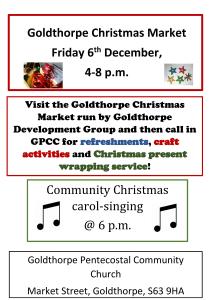
Then on Friday 6th December we have our Parent & Toddler Christmas party in the morning (always great fun!) and in the afternoon between 4 and 8 p.m., Market Street will be heaving as Goldthorpe Development Group host the Goldthorpe Christmas Market again. We’ll be open for refreshments (our luxury hot chocolate with cream and marshmallows or flakes are highly popular), craft activities and you can also have your Christmas presents wrapped! Later on, at 6 p.m., we’ll have a community carol singalong in the church car park.

Don’t forget the ‘Churches Together’ Advent Nativity (Knitivity?) Trail, which will be happening from this coming week. Knitted Nativity figures will be finding their place in shops in Thurnscoe, Goldthorpe and Bolton-on-Dearne, and children from all local primary schools will be given leaflets to fill in, telling us which figure is in which shop. Those who bring their completed sheets to the ‘Christmas Celebration’ on Saturday 14th December will have the chance to win a luxury hamper (there’s a hamper per village!) Our thanks to the army of knitters who have worked so hard to create these figures.


So there’s lots to celebrate and get involved in!
The Twisting Paths of God’s Providence
Providence is defined as ‘divine guidance or care’ and is a thread which runs through the whole Bible. It was God’s providence which led to Joseph being in the right place (Egypt) at the right time (famine) to provide for the nation of Israel. It was God’s providence which kept Moses from being killed as a baby so that in later years he could lead the nation of Israel out of Egyptian slavery in preparation for the fulfilment of His promise to give them a land flowing with milk and honey. It was God’s providence which led a foreign king (Cyrus) to look favourably on God’s exiled people and let them return to that promised land. God is always working on our behalf, even though much of this work may be behind the scenes and invisible to our natural eyes.
However, there is absolutely no doubt that Scripture teaches us that God’s providence moves in very mysterious ways! We need the benefit of hindsight usually to see what God has been doing in secret for much of our lives. Joseph could not possibly have imagined how being sold in slavery and then wrongfully imprisoned could be the path God was leading him on to become the deliverer of His people. Moses could not have imagined how forty years as a shepherd in Midian could prepare him for leading God’s nation out of slavery. The people of God who faced seventy years of exile for their rebellion and disobedience to God must have wondered about God’s love and compassion as they knew anguish and heartache.

The death of Stephen so soon after the death of Jesus must have seemed a massive blow to the early church. God had miraculously intervened to allow Peter and John to continue preaching the gospel and the church was seeing many supernatural signs and wonders, leading to explosive growth. The early chapters of Acts show us God doing marvellous things through His Holy Spirit, and then abruptly, suddenly, catastrophically, Stephen is killed. No wonder ‘godly men buried Stephen and mourned deeply for him.’ (Acts 8:2) Such great persecution followed Stephen’s death that ‘all except the apostles were scattered throughout Judea and Samaria.’ (Acts 8:1) I can imagine believers reeling, not understanding, wondering what on earth God was doing. The persecution was so great that both men and women were being imprisoned. (Acts 8:3) How could divine providence be seen in this twisting path?
And yet, with the benefit of hindsight, we see that Stephen’s death was ultimately instrumental in the conversion of the chief persecutor, Saul, who was to become the ‘apostle to the Gentiles’, responsible for church growth which made that seen hitherto in Jerusalem look like a minor church plant. Saul did not forget what he saw in Stephen’s death (he refers to it later in Acts 22:20, demonstrating the influence Stephen had on him even in dying). Moreover, the scattering of disciples away from Jerusalem, Judea and Samaria was to lead to the spread of the gospel into the whole world, just as Jesus had originally said (see Acts 1:8). With the benefit of hindsight, we can see how God’s providence used Stephen’s testimony, in word and deed, through life and death, to promote the church’s mission and how this apparently catastrophic happening (martyrdom) led to new life and a flourishing church.
In our own lives, therefore, we need to hold on to the fact that a twisting path which does not seem to be directly leading to the destination we assumed God had for us is not necessarily a sign of our sin or God’s displeasure. God is working out His purposes in our lives all the time, even at those times we would label as catastrophic or disastrous. Casting Crowns sing,
“So when you’re on your knees and answers seem so far away,
You’re not alone; stop holding on and just be held.
Your world’s not falling apart, it’s falling into place;
I’m on the throne, stop holding on and just be held.
If your eyes are on the storm,
You’ll wonder if I love you still,
But if your eyes are on the cross,
You’ll know I always have and I always will.’ (‘Just Be Held’, Casting Crowns)
Hypothetical Grace?
There is no such thing as hypothetical grace. Many of us like to plan our lives down to the nth degree and spend much time fretting about ‘what if?’ scenarios that may never happen. There’s nothing wrong with planning, and certainly I would say there’s nothing wrong with seriously considering many important questions and thinking about our answers ahead of time; it alarms me how people try to make life-changing decisions in the middle of crises without ever having considered these things beforehand. (That seems to me to be a recipe for disaster, for emotion often sweeps away common sense and logic.) Nonetheless, God gives us daily bread; His provision for us is not one based on what we may or may not need in the future.

When we read stories such as Stephen’s martyrdom (Acts 7:54-8:3), that often prompts us to consider how we would react in similar circumstances: would we have the courage and faith that he showed?
The problem we have when pondering that question is that the situation is, in all probability, outside our experience. It’s good for us to ponder the worth of Christ to us and how important He is to us. It’s good for us to dwell on His word which teaches us about opposition and persecution and about the importance of eternal life compared to the momentary sufferings we experience now (see 2 Cor 4:17-18, Rom 8:18). It’s good for us to consider these things and work out what really matters to us as well as to learn from the example of those who have gone before us and died well as martyrs. But we cannot ever know how we would feel in a situation we have never experienced before, and we certainly cannot hope to receive sustaining grace in advance. As Corrie ten Boom’s father reminded her, he did not give her train tickets weeks in advance of her journeys, but on the day of travel. ‘And so it is with God’s strength. Our wise Father in heaven knows when you are going to need things too. Today you do not need the strength to be a martyr. But as soon as you are called upon for the honour of facing death for Jesus, He will supply the strength you need—just in time.’
This doesn’t just apply to martyrdom. Paul learned that God’s grace was sufficient for him in all circumstances (2 Cor 12:9), but grace is given to us when we need it. It’s not given in advance for us to store in a jar on a shelf. We can claim God’s grace when we are in those situations beyond our ability to endure. It will always be there for us and God never runs out of it, no matter how much grace we need (James 4:6)! But we cannot hoard God’s blessings. The Israelites tried to do that with the manna they received, only to find it rotten and full of maggots. (Ex 16:19-20) We must learn to live in the present and receive God’s grace in the present. There’s no peace, no grace and no provision for the hypothetical future. There is, however, all we could ever need in the now.
Learning Through Imitation
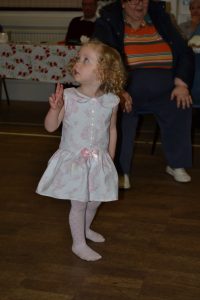
One of the first ways we learn is through imitation. We see someone doing something and we copy them. We hear speech and learn to speak ourselves by imitating what we hear. It’s so interesting (and often amusing) to watch children learn through imitation, to see them ‘play out’ scenarios they have experienced with their toys. I love watching Esther’s tea parties with soft toys when she gives them food and drink or her attempt to breast-feed her dragon through her navel in imitation of her mother’s breastfeeding of her baby sister. Watching her play charades at the church’s New Year’s Day party when she had no real understanding of the game but simply copied what she saw others doing was a joy!
There are many parallels between the death of Jesus and the death of Stephen, the first Christian martyr. Both speak of forgiveness (Jesus’s ‘“Father, forgive them, for they do not know what they are doing.” And they divided up his clothes by casting lots’ (Luke 23:33-34) and Stephen’s ‘Lord, do not hold this sin against them.’ (Acts 7:60)) Both commit their spirits to God (Jesus’s ‘Father, into your hands I commit my spirit’ (Luke 23:46)) and Stephen’s ‘Lord Jesus, receive my spirit’ (Acts 7:59)) – with Stephen’s prayer to Jesus effectively reminding us of the deity of Jesus. Both demonstrate how to die well in excruciating circumstances, showing that a life surrendered to God can face death with confidence, faith and trust.
Death is the one absolute certainty in life, and yet many of us struggle enormously with this subject. Death is often physically painful, emotionally debilitating and theologically challenging, but the Bible gives us, in Jesus and in Stephen, a blueprint for death which offers us hope and confidence to allay our fears and terrors. Death is often described (as is the case here) as ‘falling asleep’ (see also 1 Thess 4:13, 1 Cor 11:30), and few of us fear sleep at night. Jesus came to ‘free those who all their lives were held in slavery by their fear of death.’ (Heb 2:15) I don’t think it’s a coincidence that the first account of a Christian’s martyrdom contains (in the words of F. F. Bruce), this ‘unexpectedly beautiful and peaceful description of so brutal a death.’ We might rationalise the death of Jesus as being because He was the Son of God and therefore ‘different’ to us, but Stephen was an ordinary disciple who gives us hope and confidence that even in death, God is with us, welcoming us home and waiting with open arms. Even in death, we can learn and copy those who have gone before us with the full assurance that faith brings: as Bill Lane said on being told he had terminal cancer, ‘I have taught you to live well; now I will teach you to die well.’ We need role models in the art of dying well as in everything else. Stephen is one such role model.
Seeing The Invisible
Christians believe in a spiritual, invisible dimension to life, that there is more to life than meets the eye, so to speak. Our five senses (sight, hearing, touch, taste and smell) are invaluable to navigating life on earth (though many people prove they can live successfully without one or more of these), but to live life purely based on the physical and material (as atheists and humanists do) is to miss out on all that God is doing in our world.
Paul tells us that those without Christ live effectively as people blinded to the light (2 Cor 4:4). Stephen is an example to us of what happens when spiritual sight is restored. Just before his death, Stephen said, ‘I see heaven open and the Son of Man standing at the right hand of God’ (Acts 7:56) This was a bleak moment for Stephen; he was being stoned to death by a crowd furious at his testimony about Jesus Christ, and yet at the darkest moment from a physical point of view, light and life shine through. Stephen could see by faith something the crowds could not see, just as Elisha prayed for his servant’s eyes to be open to see the invisible army of God enabling him to have confidence even when foreign armies were surrounding him. (2 Kings 6:15-17)
Spiritual vision is essential if we are to stand firm in the faith no matter what comes against us. If we only use natural eyesight, we will soon become depressed, disillusioned and defeated. I can’t think of much worse than being stoned to death for blasphemy when you have done nothing wrong, but Stephen’s death as the first Christian martyr is redolent of victory and peace. As F. F. Bruce puts it, ‘Stephen has been confessing Christ before men, and now he sees Christ confessing his service to God.’ This is not an isolated experience; many others have spoken of seeing God at times when others have been impervious to the spiritual realm (including Saul himself, as we later discover!)
Paul prays for the eyes of our hearts to be enlightened (Eph 1:18) and we often sing, ‘Open the eyes of my heart, Lord.’ (Paul Baloche) There is no better prayer to pray if we are to grow spiritually and maintain a vibrant witness for Christ in our current dark days.
