

Good Friday

Good Friday.
The name always jars.
It’s only ‘good’ because we know the ending.
The challenge for us is to live in the daily sorrow with faith and hope. When we don’t know the outcome. When we don’t know resurrection is coming.
We could say those early disciples should have known. Jesus had been explicit enough with them, after all. He had talked of resurrection enough that the Romans decided to put a guard and seal on the tomb just in case someone tried to steal the body away and proclaim further insurrection through resurrection. But the disciples weren’t in any position to mount a coup d’état. They were crushed.
Everything had been hurtling to a climax in just a few hours. Imagine their feelings: disbelief that the betrayal came from within their own ranks, fear and denial, hope that the trial might result in acquittal, the agony of watching a loved one die, the sense of helplessness and hopelessness. And the questions. Those hollow, unanswered questions. Why, God? Why did You let Him die? Why didn’t You come with Your crowds of angels and rescue Him? Why?

For anyone who has been bereaved, this is familiar territory. Numbness. Denial. The sense that the world has changed irrevocably. I wonder where they all went, these women standing on Golgotha. Did they eat food that tasted like cardboard? Did they listen to other people laughing without a care in the world and want to scream? We don’t know. But Good Friday always makes us pause at the weight of sorrow.
We want to step ahead, to run to the empty tomb, to proclaim the victory. But we do well to pause here.
For most of life is spent here, in the valley of the shadow of death. In not knowing the answers. In having hope crushed and in not really understanding, for the most part, what on earth is going on.
When death comes, we feel life is impossible. Each morning, we wake to the sick knowledge that it wasn’t a dream or a nightmare; the loss is real. For many today, this is the reality of coronavirus or even cancer or heart disease or road accidents (statistics which aren’t being thrust on us in the same way.) People are not consoled by the thought of a loved one having lived a good life or sacrificing themselves for the greater good. They weep and they ache.
But death is not the end.
It takes faith to believe that.
It takes a miracle-working God to achieve that.
As we linger at the cross, we only see loss and sorrow and failure. But this is the place where the work of salvation was finished.
And for that reason, today is ‘Good Friday.’
What Are You Going To Wear Today?
Every morning we choose to get dressed. What we wear may well be determined by multiple factors: what day it is, where we are going, the chores we have to address. If we’re at work or school (if only!), we may have to wear a uniform; if we’re decorating, we may want to put on older clothes which are paint-spattered already. If we’re going out for a meal or to an official function, we may want to put on our best clothes; if we’re spending the day with children, we may want more relaxed garb.
Then there are the fashion factors we may consider about what we are going to wear: matching colours and styles, accessories, shoes and so on. It’s surprising how young children can be when they start to notice these things and decide what they want. My granddaughter already likes to wear a ‘pretty little dress’ rather than more practical tops and leggings!
Over this Lent period, I’ve tried to consider things we should consider eschewing and embracing, not simply ‘for Lent’, but for life. It’s relatively easy to change our behaviour for 40 days; it’s much harder to change over the longer-term period. All long-term change requires our cooperation with the Holy Spirit so that we allow His power to reign in our lives.
Paul makes it clear what we should wear every day in terms of our attitudes and lifestyles: ‘Therefore, as God’s chosen people, holy and dearly loved, clothe yourselves with compassion, kindness, humility, gentleness and patience.’ (Col 3:12) He tells the Ephesians, ‘to put off your old self, which is being corrupted by its deceitful desires; to be made new in the attitude of your minds; and to put on the new self, created to be like God in true righteousness and holiness.’ (Eph 4:23-24) Essentially, to eschew (put off the old self) and to embrace (put on the new self) need to be part of our daily living as Christians. Easter makes this possible.

More Easter Resources
There are some great children’s videos telling the Easter story out there. Here are a few links you may want to use to tell the story.
1. Andrew McDonough (author of the ‘Cecil The Sheep’ stories which we often use in assemblies, church and Family Fun Days) is producing videos each day in self-isolation showing children how he draws the stories and re-telling the stories, especially the Easter ones. You can watch them here. Check in each day as he’s adding new ones each day.

2. The story of Jesus’s death and resurrection told in Lego can be found here.

3. A cartoon version of the story can be found here. It lasts about 5 minutes.
4. A longer version from the Beginners’ Bible is found here. This lasts about 26 minutes.
5. The Bible Society have videos about the Easter story available to view online. One is the ‘Super Cool Story of Jesus’; another is ‘Three Friends And The Miracle Man’. You can find them here.

Holy Week Activities For Children
So for those of you with children wanting to teach about Holy Week, what can you do? Obviously you can read the story from the Bible, but children often need activities to do to help the story come to life. Here are a few suggestions for activities you can do, all of which focus on the individual elements of the story to bring this to life for children.
1. Make a Holy Week banner or wreath (see photos). These would focus on the main elements of the story, so could include palm branches (for Palm Sunday), pictures of bread and wine (for the Last Supper), making a footprint on paper (to symbolise Jesus washing the disciples’ feet), a cross, an empty grave, a crown of thorns contrasting with a crown symbolising Jesus is the King of Kings and so on. Make the pictures based on the things you discuss with your children.


2. Bake your own bread on Maundy Thursday to share the Lord’s Supper together. It’s been quite hard to find yeast in the shops lately, which would add authenticity to this activity, as the Passover had to be celebrated with unleavened bread, symbolising the haste with which the Jews had to flee Israel. A recipe can be found here. (Click on the word ‘here’ in the previous sentence to find the recipe!) As you do this, you can teach about the Passover and about the Last Supper.

3. Make a Holy Week box. This is a little bit like a Nativity set, but telling the events of Holy Week and Easter. A shoe box is ideal for this. You can even use any toys you have to represent the characters or decorate wooden pegs or wooden sticks to make your own people. You can make palm branches to act out the events of Palm Sunday and use paper drawings to act out each event (washing the disciples’ feet, the Last Supper, the Garden of Gethsemane, the journey to the cross, the crucifixion and so on.) You can either do this to be used each year or you can use things from your garden and real food just to do it for this year (e.g. stones and rocks from gardens, real bread for the Last Supper and so on.) Children often like to ‘act out’ stories.

4. Use Lego to tell the story! For those of you with children who love Lego, how about making a Lego version of the story as you read it? Imagining ourselves into the story is a very powerful way of making it come alive for us. Children have great imaginations, so it’s not hard to use Darth Vader as Herod or Pontius Pilate and other characters from films as the key characters in this story. Did you know there’s a Lego Bible? You can actually read the Easter story told using Lego here.
The pictures below are of the arrest of Jesus and His crucifixion to get your ideas going!


5. Make an Easter garden. If you’re fortunate enough to have a garden, you can probably find all you need to make your own Easter garden. For this, you need:
-
A tray
-
Soil
-
Grass seeds or moss
-
Small stones
-
A large stone
-
A piece of small white cloth
-
A small flower pot
-
6 sticks to make into 3 crosses

We’d love to see photos if you make any of these things!
Maundy Thursday
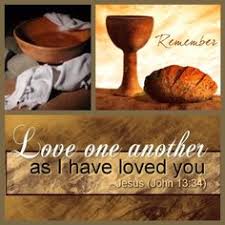
Today is Maundy Thursday, a strange name arising from the Latin word ‘mandatum’, referring to the new commandment that Jesus gave His disciples to love one another. (John 13:34-35) It’s a day when, in countless church services over the world, we remember how Jesus washed His disciples’ feet (John 13:1-17) and shared the Last Supper with them. (Luke 22:7-38) It’s also the day traditionally when the Queen gives money to ‘deserving senior citizens’ in a ceremony dating back to Edward I. (I’m giving you all a history lesson here for the children!)
As we journey through Holy Week, reading the Gospel accounts of this last week of Jesus’ life (told in far more detail than all the preceding years!), I’m struck by the chaos and confusion all around, and yet how Jesus walks through this with sorrow but also with serenity. The story of the washing of the disciples’ feet begins with the words, ‘Jesus knew that the hour had come for him to leave this world and go to the Father.‘ (John 13:1) The ‘leaving’ part would involve anguish, suffering and sorrow, but He would endure the shame of the cross because of the joy set before Him (Heb 12:2), knowing all that His death would accomplish and knowing also the joy of going to His Father. Jesus’ love for others was shown in His very mundane and humble task of washing dirty feet. We are told that we are blessed if we do such things. (John 13:17) We might not be able to wash people’s feet today, but this passage is a challenge to us to find creative ways of serving and helping other people at times like these.
So… how can we wash feet today? A phone call? An e-card or literal card posted to someone? A picture sent to a lonely person, brightening their day and reminding them they are loved? A bunch of flowers delivered to someone? Delivering shopping to an isolated person? Let’s find ways to serve others and receive God’s blessing as we do so for we are then being obedient to this new commandment.
Choose Well!
Below is a blog from Rend Collective that’s worth pondering.
“We’ve been thinking a lot about choices.
Hey Friends,
It can feel like we don’t actually have a lot of power to make decisions right now.
We can’t choose to go out for a bite to eat. Or go to the gym. Or get a haircut(how’s that working out for you?). If you’re in the U.K. you can’t even choose to go out for 2 walks in the same day!
We don’t get to pick our circumstances: but we do get to choose our response.
I love this verse in Joshua:
“Choose this day whom you will serve…but as for me and my house we will serve the Lord.”
THIS DAY. THIS MOMENT. THIS BREATH.
It’s right here that we have a decision to make. We can build our altar right here on this seemingly barren ground. Not in some theoretical future when things are “normal”(whatever that is!) but right here in the conflict and confusion, the mess of real life. We have never followed Jesus in some perfect vacuum or a Christian Disneyland – we follow Him in a broken/beautiful world.
There’s always a “virus”. There’s always suffering. There’s always hurt.
And the real people of God have always chosen to proclaim Him as good and worthy in spite and above all of that.
Faith isn’t all inspiration on the mountaintops – a lot of it is perspiration in the valleys, “working out our salvation in fear and trembling”.
There are a lot of details that we have to surrender right now.
But let’s control what we can control.
No one is forcing us to be socially distant from Jesus.
We have some agency and authority over our lives even now.
We can choose to press into Him in this season, to worship Him passionately, to soak in His word.
This isn’t just a time of waiting : this is a time of choosing.
Who are we going to decide to be when the chips are down, the shadows fall and the pain surrounds?
What are we going to do with this admittedly less-than-perfect portion of our “one wild and precious life” as Mary Oliver put it so well?
As for me and for my house, we will serve the Lord.
Love,
Rend Co.”
