

“This!”

My eighteen-month-old granddaughter has discovered a most useful word: “This!” In her early attempts to communicate verbally with us, she has become an expert at pointing dramatically and announcing, “This!”, with the unspoken subtext being, “Pass this to me; give this to me immediately!” The problem we servile adults have is that the finger often points at more than one object and we are left holding them up, one by one, in order to determine which ‘This!’ our diva is demanding. It’s an object lesson in the limitations of language and our need for her to increase her vocabulary in order to more precisely specify which particular object she desires!
Our task as Christians seems to me to be sometimes rather akin to my job at deciphering which “This!” my granddaughter requires. What is God saying to me today? What is the “This!” He wants me to look at? On what is His attention fixed? Because surely where His attention and gaze are is where my attention and gaze need to be?
The prophets repeatedly tell us “this is the word of the Lord” or “this is what the Lord says.” (2 Chron 11:4; Is 37:6, Jer 14:1, Jer 19:3, 15, for example). We all have a a need to hear this word (often called the ‘rhema word of God’, a word that is personal and specific (such as when Jesus told Peter to put down the nets after a fruitless night’s fishing.)) We need to hear the “This!” of God, for He is a God who speaks personally, specifically and directly to us.
It can be difficult at times to discern this word from the many voices crying out to us, but the more time we spend in God’s word and listening for His voice, the more we will not only hear his “This!” but will actually also know what He means by that word.
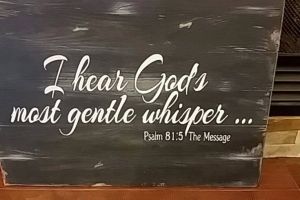
As the psalmist says, “I hear this most gentle whisper from One I never guessed would speak to me.” (Ps 81:5, The Message)
God the Potter
The central reality of life – which few of us ever seem to glimpse, let alone grasp – is that God is at the centre of everything and is the sovereign ruler of all. Jeremiah likens this to a potter who has complete control of His creations, shaping and moulding them as He sees fit. (Jer 18:4)

The doctrine of God’s sovereignty at times leads us to believe people are mere puppets of God with no free will, and this can lead to passivity and apathy. If God is in control, what point is there in striving and labouring for change?
The Bible holds in tension the truth that people are not puppets, even as it boldly proclaims God’s sovereignty. Jeremiah’s word to Israel spoke of nations repenting and God relenting as well as the opposite happening (God reconsidering the good He had planned for them if the nations continued to walk down the path of evil.) (Jer 18:5-9) We see something of the wonder of paradox in this tension between sovereignty and free will: how our prayers and behaviour can actually have an impact on God and on what He does, even if we have no explanation for how this actually works!
Now is not a time to give up and roll over, to accept passively that we are all doomed because of the current pandemic we face. It is a time to earnestly seek God and to repent of our selfish tendency to live life as though we were at the centre of the universe. It is a time to humble ourselves and to plead with God to have mercy and to relent.
Jeremiah asserted – a lone voice among the prophets, it seems – that ‘my people have forgotten me’ (Jer 18:15), calling this a ‘most horrible thing.’ God’s people are charged with remembering and proclaiming who God is: faithful, gracious, merciful, forgiving, good and kind, but also true, just, and (like the potter) right in everything He does and says. Above all, we are called to declare to those around us that ‘our God reigns!’ (Is 52:7) – not in fatalistic resignation but in confident proclamation, sure that He will do what is right. Our part is to hear Him, heed Him and live in such a way that others see and alternative to the fear and despair that are everywhere. We are called to be clay in the hands of the Master Potter, to be different to those who have no knowledge of Him. May our lives reflect His beauty as we trust daily and walk humbly with Him.
Mercy Hooks
When we are faced with loss – be that the loss of a person, the loss of a friendship or other relationship, the loss of a pet, the loss of a job or even the loss of a dream or hope – there is bereavement and often a period of grieving. That period has no set time limit and we often feel adrift on a sea of unfamiliarity. Life seems to lose its colour; we can become listless, apathetic, as though there seems little point in carrying on. All the things we took for granted suddenly seem shaken; grief takes us through different stages, including sadness, anger, resentment, bewilderment and that terrible feeling of isolation. Grief is a profoundly lonely journey, even when others long to walk with us through that time.
The truths we know about God – His goodness, love, grace, mercy, faithfulness and comfort – may seem like distant memories at best, glimpses of a land we no longer seem able to reach. At worst, we feel like Jeremiah: deceived, seduced, abandoned (see Jer 15:18, Jer 20:7). This is a time when many walk away from the Lord, convinced that He has in fact walked away from them.
How do we survive such times? How do we come through loss and grief with faith intact and even strengthened?
I believe one way is through mercy hooks, those tiny reminders of who God is and what He is really like which shine into our darkness, at first with all the force of a flickering candle, but gradually blazing forth in dazzling light which dispels every darkness and overcomes every sorrow.

Mercy, love and grace are at the heart of who God is, and He tailors these to meet us in those dark valleys. If we look, we will find these present in our darkness. It might be a friend who phones you when you’re desolate and just listens to you without judgment. It might be a sunrise whose beauty reminds you that hope comes in the morning. It might be a song whose lyrics pierce to the heart because they say what you can no longer articulate for yourself. It’s impossible to predict how God will reveal Himself in the darkness because He does this in ways that are tailor-made for you. There is no one-size-fits-all plaster for grief. Instead, there is a suffering Saviour who knows what you need.
These mercy hooks are slivers of hope when all hope seems to be gone. They are there to strengthen on an hourly basis. I remember driving to pick up a parcel on the morning after my mother had died, a tedious job to be fitted in when numbness and exhaustion from lack of sleep meant I just wanted to hide under the quilt in bed. As we drove, the most beautiful rainbow appeared in the sky, a mercy hook from God, a reminder that He always keeps His promises. I went into the depot to pick up this unknown and unwanted parcel, and opened it to find a small teddy bear wearing a jumper that said, ‘Julie’s Big Hug Bear’, a gift posted weeks before by a friend of mine in Australia who desperately wanted to offer comfort and solace to me as she walked through my mother’s cancer journey with me, arriving at exactly the right time to remind me not only of her love and support but of God’s. It didn’t stop the pain of loss, but it was a reminder, something I could physically hold onto, that I was loved, that both my friend and God cared about me. Mercy hooks.

You might have to dig in the darkness to find these rays of light, but I guarantee they are there. God cares for us so personally, so intimately, that He will not leave us comfortless. The Holy Spirit will come alongside us in our grief and give us what we need, tailor-made for us. In God’s mercy, I sat with my father doing crossword puzzles hours before a fall down the stairs unexpectedly ended his life. A mercy hook of normality that gave me strength to face sudden loss. What mercy hooks can you find in the darkness? These are not flimsy like the coat pegs on which we hang our coats and jackets. They have enough strength to steer us through the journey of grief and bring us safely home to God.
A Declaration of Dependence
The Declaration of Independence expresses the ideals on which the United States of America was founded and the reasons for its separation (independence) from Great Britain. It was the unanimous declaration of the thirteen united states of America in 1776 and is one of the most highly revered documents in American history.
I believe God calls His people to a different kind of declaration. This declaration is a declaration of dependence. Our world lives in defiant independence of God. It believes either that there is no god or that He is not worth our attention and allegiance. The Bible firmly asserts, however, that God is the creator and sustainer of our world (see Genesis 1, John 1, Hebrews 1) and that He is looking for people who will admit their need for him, confess that their ways of managing life are inadequate and contrary to His ways and laws and will turn back to Him in humble dependence. (Prov 3:5-6) He is looking for people who will trust Him unequivocally with their lives and who will love Him with all their hearts, minds, souls and strength. He is looking for people who will embrace the foolishness of God and who will live every day by faith and not by sight. (2 Cor 5:7)

By signing this declaration of dependence, each person turns their back on pride and acknowledges their own helplessness and impotence, but learns to lean on God’s omniscience and omnipotence for everyday life. By signing this declaration of dependence, each person renounces the worldview that says better government, better education and better justice systems will provide the answers for which we search and determines to live life in surrendered obedience to God. By signing this declaration of dependence, each person acknowledges that the death and resurrection of the Lord Jesus Christ are the only means of salvation for all people and identifies with that death and resurrection as the only way significant personal, communal and global transformation can be made. By signing this declaration of dependence, each person nails their colours to the mast and prays, ‘Your kingdom come, Your will be done, on earth as it is in heaven’ (Matt 6:10) – not simply in recitation but as the longing of a heart that knows nothing but God’s kingdom and God’s will ever truly satisfy mankind.
This is the declaration of dependence each Christian is called to sign. How many signatures will be added to this declaration today?

The Promise Keeper
This evening was our ‘Little Big Church’ service and Garry reminded us of God’s promises to Abraham: ‘Look up at the sky and count the stars—if indeed you can count them.” Then he said to him, “So shall your offspring be”.’ (Gen 15:5) and ‘I will surely bless you and make your descendants as numerous as the stars in the sky and as the sand on the seashore.’ (Gen 22:17) He encouraged the children to count saucers of sugar – a task that was not easy since there were so many granules! We had lots of maths to do (thankfully with the aid of a calculator) and had to acknowledge that God’s promise to Abraham would result in huge numbers!

Yet Abraham had no descendants at all when God gave him this promise, and could certainly count the two that came his way – Ishmael and Isaac. Sometimes we have to wait a long time to see God’s promises fulfilled, and in fact, Abraham died before he saw the fulfilment of the promise. He lived by faith, however, believing that God would do what He had promised (see Romans 4, Hebrews 11.)
God is a God who makes promises. Sometimes these are unconditional (e.g. Gen 8:22) and sometimes these are conditional on what we do (e.g. 2 Chron 7:14) Often, we have a part to play in the fulfilment of promises, generally through repentance and confession and turning back to God. One of the many promises God gives to us is His peace. In Is 26:3-4, we see that a condition of receiving this ‘perfect peace’ is to have minds that are steadfast, rooted in God. It’s so easy to fill our minds with things other than God, but we need to be determined to fix our hearts and minds on Him. How we approach problems matters. We should not be ostriches (pretending nothing is happening or ignoring our problems) nor optimistic without foundation; instead, we should trust God to help us through every problem. Phil 4:6-7 promises us a peace that transcends understanding, but we need to understand the link between prayer, faith and the fulfilment of God’s promises. We must not forget His promises (these are ‘Yes’ in Christ Jesus, as 2 Cor 1:20 reminds us), but must soak these in prayer and faith, trusting the Promise Maker is also the Promise Keeper. If God makes a promise to us, it is attainable; He gives us the faith to believe Him!

God Always Keeps His Promises
Children’s songs are often great (and catchy!) ways of teaching us important Biblical truths. This song (‘God Always Keep His Promises’) is a reminder to us of the faithfulness of God. As the chorus reminds us, ‘our God is good and true; He cannot lie to me and you.’ Because of this, we can be sure that God keeps His promises – even if we have to wait to see the fulfilment of them!
‘Oh, God He always keeps His promises
He said the sons of Abraham would be more than the grains of sand
And so, his family grew underneath the Pharaoh’s rule.
Oh, God He always keeps His promises
He said the blood upon the door would keep the Israelites secure
And so, He stayed His hand and led them to the Promised Land.
Our God is good and true; He cannot lie to me and you.
We can be sure of this: God always keeps His promises.
Oh, God He always keeps His promises.
He gave us laws to be obeyed and we broke every one He made
But when we ran from Him, God said He’d take care of our sin.
Oh, God He always keeps His promises.
He said His Son would set us free through His death at Calvary,
Suffered in our place, and then He rose up from the grave.’
(‘God Always Keeps His Promises’, The Ology, Sovereign Grace Kids)
