

Plough Sunday
Tonight we celebrated ‘Plough Sunday’, looking at the world of work through the eyes of our congregation. Work is God’s idea. In itself, it’s not sinful; we were created to work: ‘The Lord God took the man and put him in the Garden of Eden to work it and take care of it.’ (Gen 2:15) Work is where we spend the majority of our waking time as adults; if you’re working full-time (37 hours or more), you will spend about a quarter of your time every week on work alone.
Our work matters to God, and He has given us all skills and talents which can often be expressed through our work.In the Bible, we read about many people in the workplace: Joseph, Daniel, Nehemiah, David, Moses, Ezra and the ‘wife of noble character’ in Proverbs 31, to name a few. We read about shepherds, administrators, cupbearers to foreign kings, priests, architects, carpenters, business managers and so on. My personal favourites are Bezalel and Oholiab, creative artists filled with God’s Spirit whose metalwork and gemmology were used by God to enhance the Tabernacle, turning it from a place of functionality to a place of beauty. Throughout the Bible, we see work as something which is a gift from God and a way we can serve God and other people.
We learned about previous employment (Joan used to be a cleaner and Dave used to read gas meters, hence the meter key.)


We learned about the world of technicians, civil engineers and Garry’s work in the Robotics department at the University of Sheffield:


Garry even brought in a kilobot to show us!


Julie’s work in preaching and teaching from God’s word was represented by a sword (see Eph 6:17, Heb 4:12):

Work is not limited to paid employment, even though for most of us between the ages of 16 and our late sixties, that takes up most of our time. Volunteering (working without pay) can be a useful form of work for many people. Janet volunteered with Barnsley Superstars during the first lockdown, a group which made over 10,000 face coverings for people in our area to use.
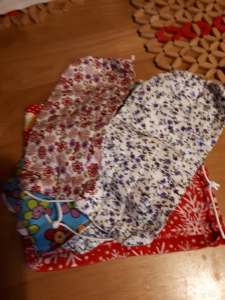
She has also been involved with packing gifts bags for the Dearne Churches Together events:

Whatever our age, we can be involved in working for God, in being His ambassadors wherever we are. We prayed for all in our congregation (many of whom are classed as key workers and are still going out to work). Others are working from home. We continue to pray for all key workers (including those we know working in the NHS and in schools), for those juggling work and homeschooling and for those who need to find new jobs or who face increasing uncertainty in their jobs as well as for those who have retired from paid employment and are still serving God in different ways. We prayed too for children and young people as they continue their work (some at home, some in school) and for God to bless us all in our ‘frontlines’ of work, wherever these are.
A Cause Worth Dying For
Dave spoke this morning from Romans 5:6-11, reminding us that we are the cause Jesus thought it was worth dying for. Sometimes we see that people are willing to die for a cause (e.g. suicide bombers and even martyrs for Christ) and people can be willing to die for a loved one (e.g. a parent for a child), but we see that God made a rational, deliberate decision to send His Son to die for us when we were His enemies. God could have looked at us and decided we weren’t worth bothering with (we tend to be more sympathetic to those whose suffering is ‘undeserved’, for example), but instead, Jesus gave His life for us even though we had made it clear we wanted nothing to do with Him.
God’s love is so great He wants restoration for us. He wants us to be able to fulfil our original purpose, to glorify Him and enjoy Him forever, but in order for this relationship to be meaningful and involve our choice, not His control, He made us with free will, and that gives us the ability to refuse God. Sin is man’s wilful disobedience, as evidenced firstly by Adam and Eve in the Garden of Eden, but then seen as an inherited condition in all mankind. All have sinned (Rom 3:23); all must pay the wages of sin (death) (Rom 6:23). We were powerless to change this situation, but God stepped in, taking the initiative in our salvation.
The birth of Jesus (born of a virgin in humility) and the crucifixion of Jesus are key events which pave the way for a reconciliation between God and humanity. We know that Jesus’s sacrificial death was counted acceptable by God because of the Resurrection, something for which there is much historical evidence (see 1 Cor 15, Acts 1:3). Now we are left with the decision: do we want to continue to live as children of Adam or do we want to become children of God?
If we want to become God’s children, this necessitates accepting our sinful status, repenting of our sin (which means both turning away from sin and turning towards God) and recognising that we need the help of Jesus. As we give our lives totally to Jesus, holding nothing back, we are born again and can live for Him with joy in our hearts.

Losing Control
I am interested by our reactions to lockdown, by the psychological impact this has on us. This is not the place to discuss the morality or efficacy (or otherwise) of lockdowns, but I am intrigued by our reactions because they seem to me to centre on one common theme: control. Most of the time, we feel in control of our lives. We can choose where we go, how we live, how we travel, what we do. Or at least, we feel as though we can choose. In reality, there are many things over which we have, at best, limited control. I don’t drive, for example, so my freedom of choice in how I travel depends on public transport, the availability and willingness of others to drive me to my destination and my ability to walk to get to where I want to go. Again, I may feel free to determine when I rise and when I go to bed, but the truth is it depends on other commitments such as work and childcare provision as well, so am I totally free? The issue I feel which causes such disquiet during lockdowns is not simply to do with healthcare or loss of freedom, however; it is loss of control. We feel other people are dictating to us what we should do and how we should live, and this causes great internal strife.

As a Christian, I am called to live by faith and not by sight. (2 Cor 5:7) Life is about trusting an invisible God every day, about giving Him control in my life. Now there is a vast difference between giving God control and giving that control to a government which (if I’m honest) doesn’t really appear to know what it’s doing, but the truth is that for human beings, giving up control is probably the hardest thing we ever do. We like to feel that we are in control; we like to feel in charge. All our lives, we have been conditioned to believe that we are the centre of the universe and that life revolves around us. It is a shock to the system to discover that we are not in charge of our own lives and that a life of faith ‘does not consist in imposing our will (or God’s will!) either on other persons or on the material world around us. Instead of making the world around us or the people around us or our own selves into the image of what we think is good, we enter the lifelong process of no longer arranging the world and the people on our terms.’ (Eugene Peterson, ‘The Jesus Way’, P 45)
This process of embracing what is given to us – ‘today’, with all its imperfections and problems – and walking with God through that gift is not easy, but it does bring with it great rewards. Eugene Peterson goes on to say that ‘every time we set out, leaving our self-defined or culture-defined state, leaving behind our partial and immature projects, a wider vista opens up before us, a landscape larger with promise.’ (ibid.) Perhaps during this time we can learn once again what it means to walk by faith, letting go of control and learning to trust God. That way, even though we may feel great frustration and even resentment and anger at times, we can also make progress in our faith journey, learning to trust God even when we do not understand what He is doing or see where He is leading.
Six Impossible Things Before Breakfast
Are you a morning person, raring to go first thing? Or are you a night owl, energised as the rest of the world heads for bed? It’s always interesting to see people in the morning: some are bleary-eyed and grumpy, taking ages to come round; others are bright-eyed and bushy-tailed, as the saying goes.

In Lewis Carroll’s fantastical book ‘Alice’s Adventures In Wonderland’, Alice has a conversation with the Queen of Hearts about impossible things:
“Alice laughed: “There’s no use trying,” she said; “one can’t believe impossible things.”
“I daresay you haven’t had much practice,” said the Queen. “When I was younger, I always did it for half an hour a day. Why, sometimes I’ve believed as many as six impossible things before breakfast.”

I don’t really think it matters whether you’re a morning lark or a night owl. The life of faith is about believing impossible things at all times of day and night in so many ways. God is a God who makes the impossible possible: ‘You do impossible things’, as the song says (‘Impossible Things’, Chris Tomlin) I think the Queen is right in telling Alice that practice is important if you want to believe impossible things. It doesn’t come naturally; believing the impossible requires commitment and effort!
Following God requires impossible faith. It requires us to believe the ‘impossible promises‘ He makes: that a 100 year old man will have a son, that the walls of an impregnable city will fall as people march around, that a giant can be slayed by a young man with a sling and five stones. It requires us to believe that the sea can part in front of us and give us safe passage; it requires us to trust that God is greater than fiery furnaces and lions’ dens. It requires us to look death in the face and believe there is more than our eyes can see.
At this time of doom and gloom, when we are bombarded with negativity on a daily basis, we need eyes of faith and committed hearts if we are to be the people God wants us to be. He wants us to believe more than six impossible things before breakfast, because He is the God of the impossible. As we stand on the promises of God, we know that ‘no matter how many promises God has made, they are “Yes” in Christ. And so through him the “Amen” is spoken by us to the glory of God.‘ (2 Cor 1:20)

Faith means speaking that ‘Amen’, agreeing with God that what He has said, He will do. As we do this, the impossible things become possible. We might not experience shrinking potions and talking cats as Alice did, but we will surely see the impossible happen as we align ourselves with the God for whom nothing is too difficult. (Jer 32:17)
God’s Promises
Many of us feel that what God requires from us is impossible. To Abram, God’s requirement was to ‘walk before me faithfully and be blameless.’ (Gen 17:1) Micah summarised God’s requirements for all people: ‘to act justly and to love mercy and to walk humbly with your God.’ (Micah 6:8) Jesus said, ‘Unless your righteousness surpasses that of the Pharisees and the teachers of the law, you will certainly not enter the kingdom of heaven.’ (Matt 5:20)
When we read such verses, it’s very easy for our hearts to fail, for us to give up. ‘What’s the use?’ we may say. ‘We can never please God enough; we can never live consistently enough to meet these requirements.’ We may well feel doomed to failure and may even resent God for setting the bar so high. How can we be perfect as our heavenly Father is perfect? (Matt 5:48)

But before we sink into despair and allow ourselves to give up, we must see that God’s promises far exceed His requirements. To Abram, He promised the whole world would be blessed. (Gen 17:3-8) To the disciples, Jesus promised life in all its fulness and freedom from condemnation (see John 10, John 3). God’s promises involve the impossible: ‘Will a son be born to a man a hundred years old? Will Sarah bear a child at the age of ninety?’ (Gen 17:17) Abram could not fully comprehend the scope of what God promised him and continued to seek ways to reduce those promises to his manageable, visible world (‘If only Ishmael might live under Your blessing!’ Gen 17:18) God wanted to do something far greater than bless the son conceived out of Abram’s micro-management (though in His mercy, He did not forget Ishmael!) God wanted to demonstrate to Abram that nothing was too hard for Him. (Gen 18:14)

Grunge Texture Background
We need not fear that God will ask anything of us which, by His grace, He will not supply the means to achieve. His side of the covenant is far greater than anything we are required to do. Our response, like Abram’s, should be to fall facedown in awe. (Gen 17:3, 17) When we see God for who He is, we are amazed at the vastness of His promises to us (see Ps 8). Who are we, that God should promise so much? May this be the year when we embrace God’s promises with faith and thus see the continuation of God’s covenant promises in our generation.
Epiphany Prayer
Today was our first ‘Churches Together’ prayer meeting of 2021 and we looked at Matthew 2:1-12 as we meditated on the visit of the Magi to Jesus and used these thoughts as the basis for our prayers.
The Magi were searching for something. Many today are searching for things – happiness, wealth, health, prosperity, good relationships. Many are also seeking truth, answers and even God. We prayed for all who seek to find (Matt 7:7-8)

The Magi travelled from the East to find Jesus. We prayed for all who have travelled, fleeing persecution and war, and for those who work to help refugees. We prayed also for the travel industry at this difficult time and for all who still have to travel for their work.

The Magi were wealthy and wise. They used their wealth to bring gifts to Jesus. We prayed for all with wealth and power to have spiritual wisdom and to use wealth wisely, for the benefit of others. We also prayed that we may be generous as they were, sharing with others in need. We prayed also for all in authority, especially our Government and local and church leaders at this time and for regeneration in our area: economic, physical and spiritual.


The Magi came to worship a King who was a baby. We prayed for families in our churches and local areas, for parents who may well be struggling at this time of lockdown to juggle work and homeschooling, for teachers and children and young people at nurseries, schools and universities. We long for our playgroups and children’s ministries to be able to re-open safely and prayed for the work of local churches in reaching out to families and children and young people.


The Magi were led by a star, a divine sign. We prayed that we will all know the leading and guidance of the Holy Spirit, individually and as churches, throughout 2021.

To conclude, we added our fingerprints to a star as our ‘Amen’ to these prayers.
