

Community Service
On Tuesday, a man wandered in to the Railway Embankment site as we were painting. His car was being serviced in the garage opposite and he had time to kill, so, seeing the open gates, he decided to explore.
It must have seemed an odd sight to him: five people in various stages of painting a wall. He asked if we were doing community service (meaning a scheme whereby offenders do jobs in the community to atone for their misdemeanours.)
Of course, we were doing community service – just not quite in the way he meant! We were serving our community by giving up our time and talents to paint a mural for our community. Volunteering is very different to being mandated to do good. Here, people were doing good because they love where they live and wanted to enhance the beauty of the place.


Our church’s strapline (a phrase I detest) is ‘with God in the community, with God for the community.’ Our name is Goldthorpe Pentecostal Community Church. This is the reason I have spent so much time at the Railway Embankment this week. It has been a labour of love. I’m no fan of painting. I dislike the mess. I tremble every time I set foot on a stepladder. But I beleive passionately that God wants to do something beautiful in Goldthope and that this art project can be one way of serving Him in the community.
Community service – a way of living out your faith right where you live!
The Bigger Picture
Working on the Railway Embankment art mural this week has been an object lesson, a parable, on life itself, and especially how we need the ‘bigger picture’ to see well.
Most of the week was spent close to a very large wall, painting odd shapes. It was not always easy to see if the surface had been fully painted or not, especially when painting light grey on white or a lighter shade of green on a darker one. The only foolproof way to check was to stand further back and assess from a distance.


Similarly, when up close, it was impossible to tell what we were painting at all. Only when we backed away and looked from a distance did the funny shapes become hill contours and the blobs become clouds.
Life is like this. When viewed up close, in the immediacy of the ‘now’ with all its crises, catastrophes and calamities, it’s hard to discern any pattern at all, let alone work out how God is working for good in all these things. But with the benefit of hindsight or the chance to gain some eternal perspective on our lives, we see that He is making everything beautiful in its time. (Eccl 3:11)
We need to see the ‘bigger picture.’ Just as we trusted our artist to bring a beautiful overall picture to completion, so we must trust God to make our lives beautiful, things that will bring glory to Him, however messy they may look in the making.

A Work Of Art
I have been privileged this week to be involved in the creation of a work of art at the Railway Embankment in Goldthorpe. It’s an experience that has enriched my life in ways that are difficult to articulate.
When I was at school, art was one of my least favourite lessons. I lacked the skill, talent and imagination either to recreate what I saw or to create something original. I still don’t consider myself skilled at drawing, colouring or painting, so my ‘art’ has been very functional. My four-year-old granddaughter can do better works of art than I can!
Since starting the Dearne Community Arts’ Festival in 2017, I have, however, had the privilege of watching many artists at work and being invited into their world, and I have seen something of their skill and vision. The thing that most impresses me is their humility (they don’t think their talent is really beyond that of mere mortals as I do!), and also the way they work.
Lydia Caprani, the Hull-based artist who has designed and overseen the art mural at the Railway Embankment, has been a joy to watch. We started with a very large rectangular white canvas (aka a brick wall), and with chalk she would each day draw squiggly lines on this canvas and let us loose painting by letters (DG for dark green, LG for light green and so on.) These small, manageable sections did not seem beyond the capabilities of any one of us.
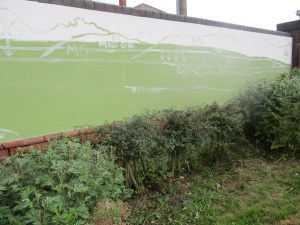
Then she drew more chalk lines, more random shapes, more letters, and we would paint those. Slowly but surely, shapes began to emerge – sky, grass, bushes. The contours of hills were emerging.

This process somehow did not seem as intimidating as being asked to ‘paint a landscape’ on a blank canvas. It’s gradual, manageable. It’s do-able. Suddenly, the picture was recognisable: there was a train hurtling through countryside. Suddenly, this is art.


Every time we view a finished work of art, listen to a completed piece of music, see a finished craft, we are awed – and possibly daunted. “I could never do that,” we say, and then shrug and don’t ever even try. But every created thing like this involves a process of little steps and these, with time and patience, can be learned. I’m working with my granddaughter on handwriting at the moment. Hers is large and rather messy now, letters not always correctly formed, sizing uneven. But as she practises each day, it’s becoming more recognisable and neat.
Life is not so much about arriving at a finished product instantaneously (it took 14 people well over 30 hours to paint this mural), but about the process of little steps that take us to our destination. We are ongoing works of art. Each one of us is being designed by God. We are His masterpiece, and each little step of faith and obedience takes us further on the journey towards that finished masterpiece. We may not see the masterpiece yet, but we can trust Him as the ultimate artist to complete His work of art in us.

DCAF Community Art Project
This week sees the painting of the art mural at the Railway Embankment site in Goldthorpe, part of the Dearne Community Arts’ Festival community art project. The vision behind this project is to leave a legacy of colour and beauty in our area, inspired by Isaiah 61:3 which talks of God bestowing a crown of beauty instead of ashes. Two to three years ago during a ‘Churches Together’ prayer meeting, God reminded us of this verse and spoke about how creativity would replace the literal and spiritual blackness associated with the town’s mining heritage with colour and vibrancy and beauty. It seems appropriate that this art project aims to do this at the site of the former pit railway.
The project has been a long time in fulfilment, postponed from last year because of the pandemic. Today, artist Lydia Caprani joined local volunteers to begin the work of sketching out the mural, which will feature a train in countryside. As with all projects, we started with a blank canvas (itself the result of a lot of behind-the-scenes work from the Dearne Area Team to get the wall rendered by Network Rail).


A lot of work has gone on today to create the backdrop for the train. Please continue to pray for fine weather and the completion of this project this week.


Forget-Me-Not
In our ‘Little Big Church’ service tonight, Stephen looked at Jonah, the prophet who did not want to listen to God’s command to go to Nineveh and who ran away in the opposite direction. So often, we don’t listen well and fail to respond to instructions, but it’s always important to listen to God and to obey Him. We might find it hard to know how to hear God’s voice, but the more we read God’s word, the more we can understand what God wants from us and how He wants us to live.
The writer of Proverbs has good advice for all of us, especially the young: ‘My son, do not forget my teaching, but keep my commands in your heart, for they will prolong your life many years and bring you peace and prosperity.’ (Prov 3:1-2) It’s important not to forget what we are taught. The idea of a child learning from a parent’s instruction is continued in Prov 4:1 – ‘Listen, my sons, to a father’s instruction; pay attention and gain understanding.‘ We are all prone to forgetfulness, and so Stephen gave out forget-me-not seeds so that when the flowers grow, we are reminded of the need not to forget God or ignore Him as Jonah initially did. If we pay attention first time around, we’re less likely to get into trouble – and hopefully avoid being thrown overboard in a storm at sea!

A Grave Hope
Dave spoke this morning from 1 Thess 4:13-18, a passage written by Paul to encourage the Thessalonians when facing the grief death brings. We may have many questions about heaven, such as will we know our loved ones there and is it unspiritual to want to? Paul does not tell them not to feel grief, for death brings a separation on earth that is painful for us, but he distinguishes between two types of grief. Even Jesus wept at the death of Lazarus; when we are parted from our loved ones, there are tears and pain. However, we do not grieve as those without hope, for we have a hope that goes beyond the grave.
The hope of eternal life is foreshadowed in the Old Testament (see Is 25:6-9) and this is not simply a psychological trick to help us continue after the death of a lovely ones. Paul tells us that the resurrection of Christ is rooted in fact and this guarantees to us the future resurrection of others. Christ is the first fruit, and therefore the hope of our resurrection is based on His. We do not know when Christ will return and so it is important to be ready for this; not all will die as 1 Cor 15:51-53 also affirms. We are eagerly looking forward to this day because we shall then know the transformation of our mortal bodies (Phil 3:21-22) and so we can encourage one another, even when facing death, because we know there is more to come, there will ultimately be no separation then and we will be with the Lord forever. Without Christ, we are lost forever, but with Him, we have a glorious future!
